
Views from the Commons
Posts Filtered by Tag - Gaza |
Show Recent Posts
August 16, 2025
Israelis Are (Almost) All In on Genocide
Israelis Are (Almost) All In on Genocide
Israeli is starving and bombing Gaza to death. Only a small minority of Israelis think that's a problem.
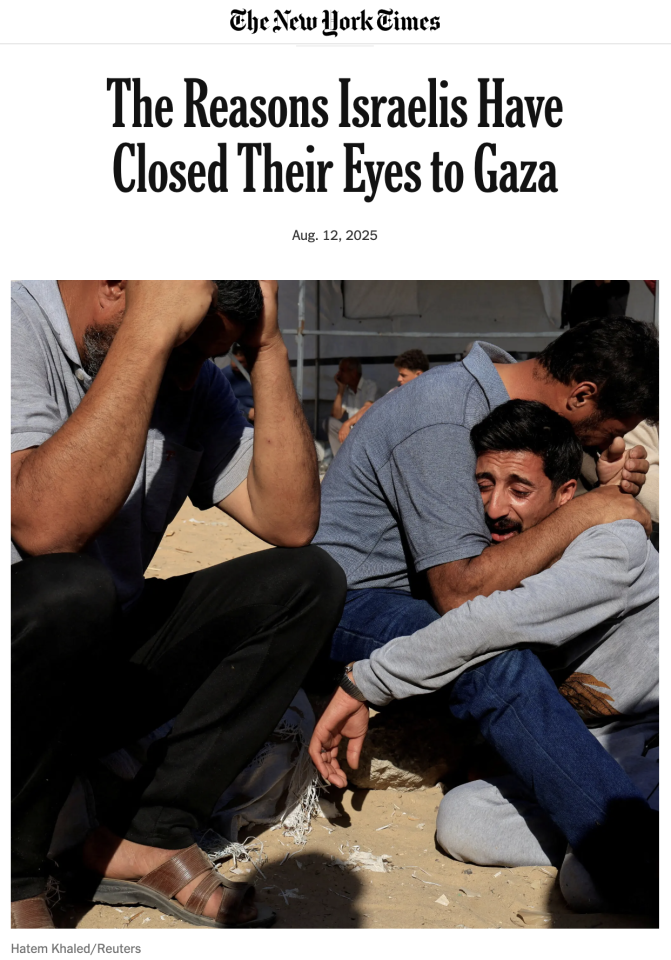
A recent public Facebook post referenced this article, which offered the following sober assessment:
Israel’s decision to cut off all aid in March pushed the strip into the dire crisis it faces today. Israel said that it hoped the blockade would disrupt Hamas’s ability to profit from the goods coming in, weaken the group’s governance and pressure it to capitulate in cease-fire negotiations. This was not just a morally wrong choice — humanitarian aid should not be a political issue — but a strategically foolish one that misread both Hamas and the international community. A humanitarian catastrophe in Gaza was never going to force Hamas’s hand. The group needs very few resources to operate: just enough to continue to hold the hostages, carry out guerrilla attacks and continue making statements to influence public opinion.
The author of the post, Gili Getz, had this to say, and offered a different quote from the article:
Over the past three weeks, I've noticed a significant shift within the pro-Israel community in the U.S. largely due to the undeniable level of starvation caused by Israel and the decision to “occupy Gaza”. This shift will accelerate.
“When it comes to Gaza, Israelis live in an echo chamber, relying largely on local media, which often enacts self-censorship regarding Israeli wrongdoing and Palestinian suffering in Gaza. But it is also important to understand the powerful underlying emotions that have led many Israelis to close their eyes and ears to the suffering of Gazans and accept a different version of reality.”
Is there sad irony in the fact that the response from Israelis confirmed the thesis of the article? There was consensus in the comments around "finishing the job," annihilating Hamas entirely. Which led me to say:
To eliminate Hamas from Gaza, every living thing in Gaza would have to be destroyed. That wouldn’t end Hamas, just evict them from Gaza. Is that what you are advocating? Killing over one million children?
I got no response. But the tone of the conversation was that I was being unrealistic in seeking peace, the implication being that yes, starving as many people and killing as many children as is necessary to rip Hamas out branch and root is what must be done.
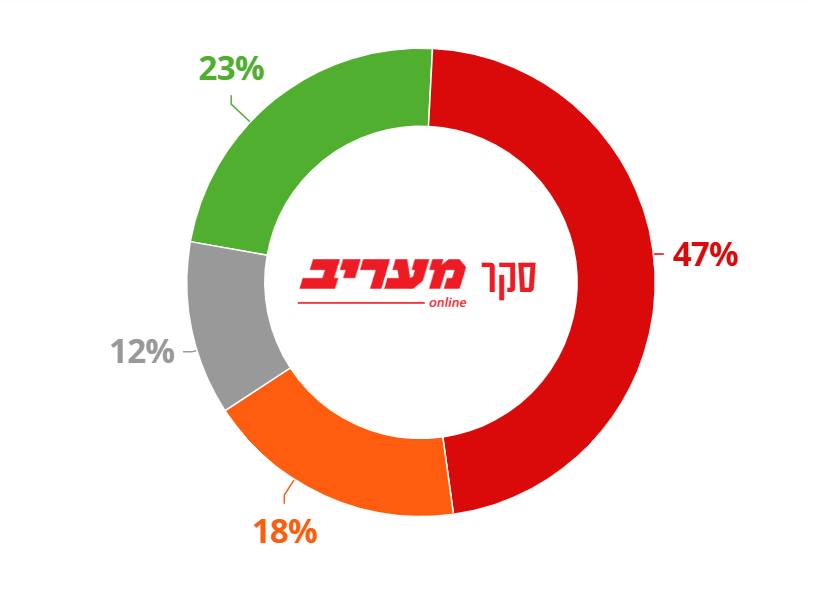
While surveys show total war is supported by only about 18% of Israelis, a majority are content to push their heads into the sand in one way or another. Ori Hanan Weisberg sums it up this way:
Ori said:
A follow-up to yesterday's post triggered (in all senses) by the Israel Democracy Institute's finding that 79% of Israelis are unconcerned about starvation/famine in Gaza.
Here is the graph of a poll from last week done by the Hebrew Ma'ariv daily newspaper on the subject:
Red (47%) - There's no famine and starvation in Gaza, it's all Hamas lies.
Green (23%) - There's famine and starvation and I care.
Orange (18%) - There's famine and starvation and I don't care.
Gray (12%) - No opinion
Ori goes on to say:
The denialists (47%), in my view, cannot be doing their due diligence. To say it's not happening at all is to deny mountains of evidence. The disengaged (12%) aren't better; in some senses they are worse. The first may plead media manipulation. The second only apathy, which I find perhaps the most damning. Atrocities don't occur without both denialism and disengagement.
Returning to the comment thread on Gili's post, this relevant exchange unfolded. A poster said:
You wouldn’t let Nazis roam around after WW2. It needs to end and we need to end them.
I pointed out that, in fact, Nazis were everywhere in Germany and beyond after WW2, including in the US. The commenter replied:
98% of Germans were Nazis. Are Palestinians 98% Hamas? Yeah maybe.
This mindset that we ought to kill 98% of Gazans but might not be able to serves to inhibit justice, not promote it. Yet there is a way forward, albeit one that requires cold calculation in place of hot, trauma-induced anger.
Only a maximum of 10% of Germans ever belonged to the Nazi party. Earning 37% of the vote in the Reichstag gave Nazis enough power for a full takeover. It’s more accurate to say the majority of the German population was complicit in allowing the Nazis to take over their country than to say that virtually all of them were Nazis.
In the last free election in Gaza, Hamas earned 40% of the vote and similarly took full control.
Evidence suggests that low-level complicity in enabling terrorists or genocidal sociopaths doesn’t make humans irredeemable. In World War II, a majority of Americans did not hold individual German citizens responsible for Nazi atrocities. As a rule, Nazi POWs on US soil were treated in accordance with the Geneva Convention. About 1% of the 400K POWs housed in the US found clever ways to stay after the war and eventually earned citizenship. Others returned to the US after being briefly repatriated. Treating Germans humanely paid dividends in helping to rapidly bury Nazism in Germany, to the extent that any viral, terroristic ideology can be buried.
In contrast, overly generous treatment of Confederate states in the aftermath of the Civil War led to traitors rapidly regaining political power in Washington, with which they killed off Reconstruction and enabled 100 years of Jim Crow violence and discrimination.
Given that these and many other robust historical models exist, a balanced, humane way to peace in Gaza might be found. Instead, Israel is well on its way to committing genocide in Gaza. Put that on Netanyahu and everyone who enables him, including the US. Without a major course correction, conflict in Gaza won’t end well for anyone, and won’t result in the security Israel strives for. And, by what means would Israel be rehabilitated after committing its own atrocity?
Postscript 1
One additional comment thread to unpack...
What about what Israel was doing to the Palestinians before October 7? Learn your history and it’s not your land.
This comment started out promisingly—there is much to discover by tracing history from Jewish immigration under British rule to present-day Gaza—then pivoted inexplicably and unhelpfully to the "it's not your land" argument of American progressives.
Gili issued this concise and civil retort:
It’s the land of both people. Don’t dehumanize and condescend here. I want this to end no less than you.
Another commenter traced the long Jewish history written into the land of present-day Israel, then said this:
The land belongs to both peoples and 2,000,000 Palestinians who enjoy living in a democratic state, as opposed to those in Gaza and the West Bank as well as Jordan.
Again, a promising start, but denigrating some Palestinians while praising others based solely on their current geographic location ignores Israel's complex historical connection to displacing Palestinians, creating problematic conditions for Palestinians in its immediate vicinity, and discrimination faced by Palestinians within Israel's borders.
Could common ground be reached were these two commenters to sit down with a regional map and history book?
Postscript 2
The ease with which both Hamas and Hitler rose to power as members of minority parties should give Americans great pause. Trump owns all three branches of government and earned a majority of the vote in 2024. His dictatorial inclinations are all full display and there is no sign that he will be brought to heel.

March 25, 2024
Hardened Bigotry and Fading Hope
by Hal Wright
Hardened Bigotry and Fading Hope
by Hal Wright
As Israelis and Gazans fall in line with their violent and incompetent leaders, a framework which could yield lasting peace becomes impossible to imagine, yet alone build.

I haven't blogged about Gaza since my broad characterization of the politics of the war a few months ago. The reason is simple. When something is falling, the next noteworthy event is when it crashes to the ground.
The horror in Gaza has worsened by an order of magnitude or more without tangible change to the fundamentals. Hamas and Netanyahu are doing what they promised, without regard for their standing in the world. Both have grown more popular within their own populations, as they have expanded, in word and deed, their dehumanization of the humans on the other side. And as Gazan civilians starve or are blown to bits, genocide moves closer to an apt description of the reality on the ground. Apologists on both sides make arguments hobbled by outright lies, and by glaring omissions: either that 10/7 happened (on the Hamas side) or that the Nakba happened (on the Israeli side). By not articulating a post-war plan for Gaza, Netanyahu has signaled his intention to turn Gaza into an open-air prison, deprived of resources and isolated as never before, for anyone who survives his onslaught.
Rafah is about to become the white hot center of Gaza. Barring an unlikely change in the momentum of the conflict, Netanyahu will set in motion one of the worst humanitarian disasters in history. By the numbers, Rafah already has the same population as Philadelphia, 1.5 million, crammed into 1/6 of the area, and with a small fraction of Philadelphia's life-sustaining resources. An invasion would result in mass civilian casualties and obliteration of those resources.
Rafah is about to become the white hot center of Gaza. Barring an unlikely change in the momentum of the conflict, Netanyahu will set in motion one of the worst humanitarian disasters in history. By the numbers, Rafah already has the same population as Philadelphia, 1.5 million, crammed into 1/6 of the area, and with a small fraction of Philadelphia's life-sustaining resources. An invasion would result in mass civilian casualties and obliteration of those resources.
There is an element of desperation in Netanyahu's latest public statements and actions. Despite having predicted that the war in Gaza would extend for many months, perhaps into 2025, Netanyahu now claims total victory will be achieved within a few weeks of his invasion of Rafah. There is no longer much talk about bringing the hostages home, and no plan to do so. Thumbing his nose at international pressure and especially at the Biden administration, Netanyahu has continued to expand West Bank settlements. While his defiant posture is not sustainable for the long term, Netanyahu seems more interested in extending his time in power for the short term.
The details of the impending crash in Gaza, and the broad scatter of debris from that crash into the Middle East and elsewhere, remain to be seen. What seems certain, and it's horrible to contemplate, is that the body count of the crash will dwarf that we have experienced so far. Demolishing Gaza may prevent Hamas terrorists from using their tunnels to invade Israel from the west. But as we have seen this week in Russia, nowhere in the world is safe from terrorism, and Israel's enemies must be doubly motivated to continue the emerging cycle of vengeance.
December 23, 2023
Talking About Gaza and Finding Out
by Hal Wright
Talking About Gaza and Finding Out
by Hal Wright
As a citizen of the United States and a compassionate human, and thus a stakeholder in the Israeli-Hamas conflict, my goal has been to draw evidence-based conclusions amidst an emotionally-charged, trauma-inducing crisis. It's not a surprise that some people are very unhappy with me.
Since October 7, I've been called both an ignorant Zionist and an unkind antisemite on social media. Having taught teenagers for 30 years, I've been called worse. And as is the case for teenagers, most of the name-calling boils down to fear and panic, the companions of war. Either friends (and former friends) needed that I be in lockstep with their partisan views, or they needed a punching bag, or both. My empathy for them has not diminished. But their rhetoric is counterproductive and must be addressed.
I was called a Zionist for stating that Israel has a right to exist, that Hamas is a terrorist organization, and that it was necessary for Israel to go to war after October 7. I was called an antisemite for stating that Netanyahu supported Hamas before he began trying to destroy it. The first statement is an opinion, the second, a fact. The statements require context which I am attempting to provide here and in social media posts. Because whenever I criticize Hamas or Israel, the listener assumes I’m fully aligned with the opposite side, which could not be further from the truth.
The Rhetoric
I have been accused of not knowing what it’s like to be Jewish or to be Palestinian in this moment, and that much is true. I do know how to take apart an argument, though. When an argument uses (or implies) the phrases “our people” and “their people,” invariably “our people” will be portrayed as innocent victims worthy of total security and “their people” will be dehumanized such that slaughtering them is morally acceptable. When an argument starts the clock at October 7 or fast-forwards through October 7 it is cherry-picking facts. When an argument contains the phrase “from the river to the sea” or rejects a two-state solution it will go on to rationalize ethnic cleansing or murder. When an argument delineates all the abuses one side committed against the other it is using the past to justify violence, not looking forward to find peace. When a person “hates Hamas” or “hates Netanyahu,” without condemning their respective atrocities, the “hate” is performative.
Both sides attempt to wrest the mantle of victimhood from the other and both decry the silence of ordinary people in the middle. The Nakba was prompted either by Israeli ethnic cleansing or by invading Arabs. (The Nakba was prompted by both.) Israel has been exceedingly patient while under constant bombardment or it has ruthlessly expanded its borders. (Israel has by turns been both compassionate and exceedingly callous and greedy.) Israel is committing genocide, or it is minimizing civilian casualties as it obliterates Hamas. (Israel hasn't committed genocide, yet.)
Perhaps the silence of people in the middle stems less from antisemitism or Islamophobia and more from not wanting to set foot into a propagandistic morass. Perhaps the only people motivated to remain engaged are thick-skinned policy wonks like me who want to end the violence, avoid an expansion of the war, and protect United States interests in an increasingly incendiary environment.
The Conflict
Hamas has bluntly and viciously left no doubt about who they are. Believe them. Their attacks are personal, eye-to-eye. They rape and mutilate Israeli women, take civilian hostages, and kill people one at a time in front of their family members, with no viable military objective. It's the very definition of terrorism.
Israeli attacks, mechanized and impersonal, are much more deadly. Israel is the 500-pound gorilla in this conflict. And Israel has committed war crimes. It would take a wiser man than I to parse out a moral hierarchy regarding the killing of children in front of their parents with a knife or by demolishing an entire neighborhood in the faint hope that a single high-level terrorist might be killed. The difference in the body count, now 20-1 but heading to 100-1 or more, cannot be excused. Call it what you will, the carnage is just the same.
Rape, targeting and murdering civilians, using phosphorus, attacking and disabling hospitals, intentionally cutting off utilities and supplies needed by civilians to sustain life — I know these are war crimes. I have eyes to see and a heart to break.
Hamas must be weakened to where it can never attack Israel again. But methodology, given the deadly consequences, matters. I stand with the Biden administration, which wants Israel to proceed more deliberately and surgically and to begin imagining a humane political and rebuilding process after conflict ceases; in short, to acknowledge the basic civil and economic rights of Palestinians. I wish Biden and Congress would give this message teeth by linking aid to Israel's strategic plan.
The Politics
The Israeli-Hamas war represents a spectacular, horrific failure of politics on both sides. Hamas and Netanyahu rely on rage and hate to stay in power. And so far, ordinary people on both sides are giving them more than enough rage and hate to fuel a catastrophic war. At the same time, Hamas was unpopular prior to October 7 (though it's popularity has increased during Israel's invasion), while Netanyahu was unpopular prior to 10/7 and has remained so. Hamas is a brutal authoritarian regime which cares very little about popularity. Israel is a democracy, albeit not quite democratic enough to rid itself of its flawed, authoritarian leader.
The lack of a post-war plan where Palestinian civil rights are respected further unnerves (and radicalizes) a forsaken Gazan population under unprecedented siege. Given abuses by Israeli settlers on the West Bank, it's disingenuous to claim that all would be well in Gaza if Hamas simply laid down their weapons. All wasn't well before and, things being equal, it will be worse after.
The full spectrum of Netanyahu's incompetence boggles the mind. He has given settlers free rein to loot, vandalize, and brutalize Palestinians on the West Bank. Simultaneously he has propped up Hamas in order to thwart a two-state solution. Where 10/7 is concerned, he was asleep at the switch in spite of one full year of warnings that Hamas was preparing to attack. A cynic would say he welcomed an attack as pretext to demolish Gaza (and to attack Hezbollah); a less conspiratorial view is that he is the most stupid person ever to lead a modern democracy.
On the other side, turning the entirety of an unincorporated, densely populated territory into a rocket-firing military fortification disqualifies Hamas from claiming they have any regard at all for lives of ordinary Palestinians. And their continued refusal to acknowledge the right of Israel to exist and indeed Jewish people to stay alive made devastation in Gaza of some form or another inevitable.
The History and the Way Forward
After World War II, something had to be done to protect the Jewish diaspora. Any solution was bound to be messy and probably deadly. In this forum, I neither condemn nor endorse the actual process by which Israel was created. It's not that I don't have opinions. It's that, after 75 years, it is what it is. I understand why many Palestinians regard the formation of Israel as a type of euro-centric colonialism. I understand why many Jewish people defend Israel with the intensity of a population facing existential crisis.
I have angered both sides by focusing mostly on the present and only a little on this history. I have been accused of not knowing anything about the history of Palestine because I haven't mentioned it much. For me though, an obsession with the past is why Hamas felt obligated to attack on October 7. An obsession with the past is why Israeli leaders feels obligated to level most of Gaza and to place Gaza's entire population in mortal jeopardy. Such obsessions are predictable human reactions to ongoing trauma. Tormented by their memories, people between the river and the sea and their allies experience perpetual, heartbreaking misery.
Israel isn't going anywhere. Palestinians will remain aggrieved, oppressed and scattered until they have a homeland. The answer, a two-state solution with economically-connected enclaves, is staring us all in the face. Until ordinary Palestinians and Israelis see themselves as members of the same group — victims of dysfunctional governments and the bloodthirsty minorities which support them — there will be no peace. While a coalition of the peaceful seems now, as it did in 1948, over the horizon and out of reach, such a coalition is the only hope.
SEARCH NEWS ITEMS
SEARCH ARTICLES
POSTS BY TYPE
POSTS BY TAG
POSTS BY MONTH