
Views from the Commons
Posts Filtered by Month - August 2025 |
Show Recent Posts
August 27, 2025
How Shall We Define Taconomics?
How Shall We Define Taconomics?
... In which a VoteVets meme leads to robust, generally civil discussion of how to classify what Trump is doing to our economy.
VoteVets, an anti-Trump and somewhat left leaning political organization, today posted this meme:
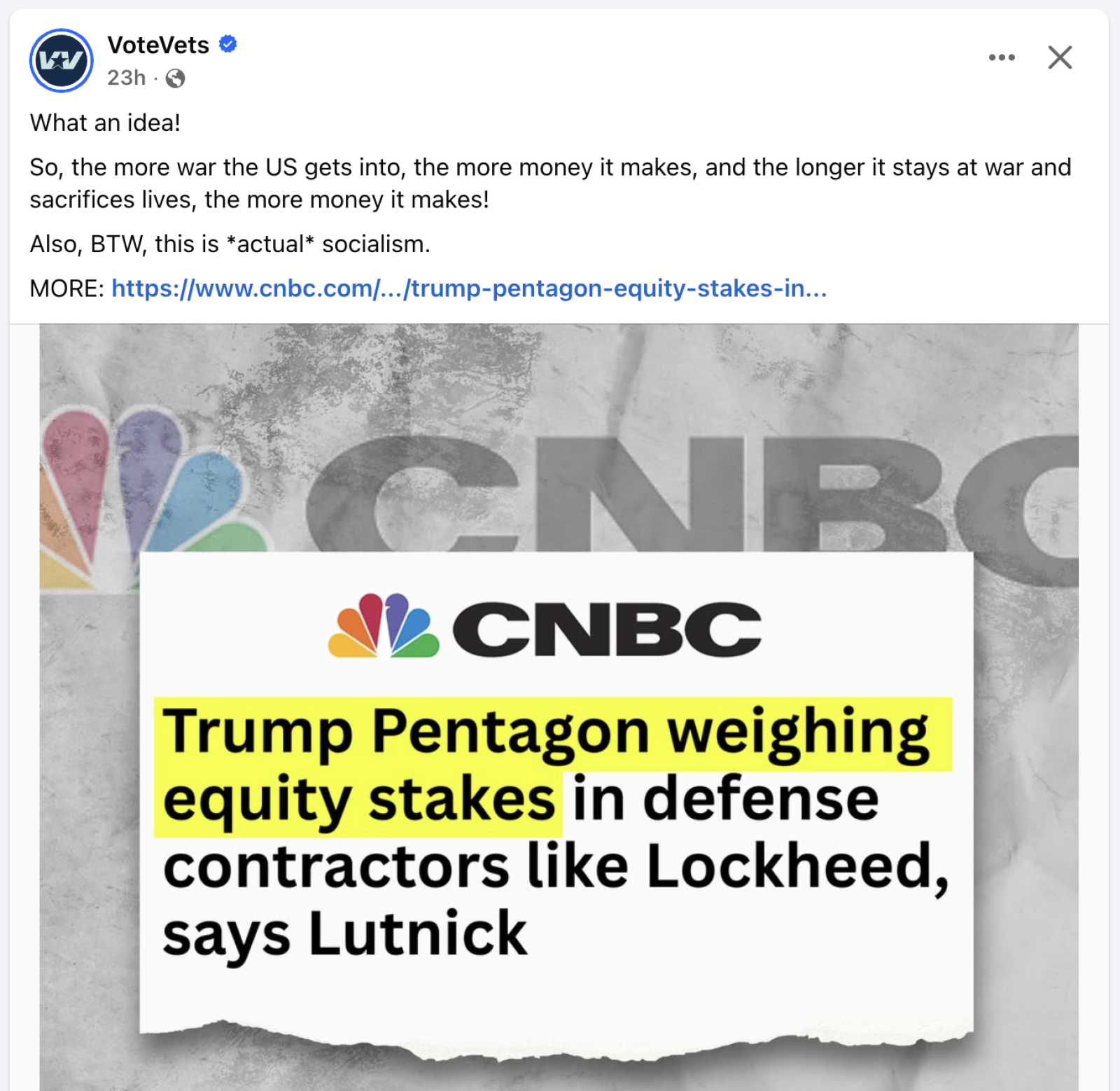
The CNBC story could yield a dozen memes more provocative than this one, given the bravado expressed by Trump and his minions. Trump said he would do deals like this "all day long."
Lutnick's announcement comes on the heels of the US government using CHIPS Act money to acquire a 10% stake in Intel, prompting libertarian Senator Rand Paul (R-KY) to write, "If socialism is government owning the means of production, wouldn’t the government owning part of Intel be a step toward socialism?" Are state-owned equity stakes in private companies really socialism, or something else?
In the comments of the VoteVets post, an interesting and generally civil* conversation is unfolding about what to call what one commenter labeled "Taconomics"—a term which deserves to catch on if it it's not catching on already.
* Commenters are calling Commerce Secretary Howard Lutnick "Nutlick," or alternatively, "Buttlick." Which, who can blame them?
* Commenters are calling Commerce Secretary Howard Lutnick "Nutlick," or alternatively, "Buttlick." Which, who can blame them?
John Davis posted this summary, which AI ought to show every time someone Googles the difference between socialism and communism:
Socialism
• Core Idea: The means of production (factories, resources, services) are owned or regulated by the community or the state to ensure fair distribution of wealth.
• Ownership: Can be mixed — both government and private ownership may exist.
• Economy: Still allows for markets, competition, and private property to some degree.
• Goal: Reduce inequality by providing social safety nets (healthcare, education, welfare, etc.) and limiting extreme wealth gaps.
• Examples in practice: Modern Scandinavian countries (like Sweden, Denmark, Norway) blend capitalism with strong social programs → often called “democratic socialism” or “social democracy.”
Communism
• Core Idea: A classless, stateless society where all property is commonly owned, and wealth is distributed strictly “according to need.”
• Ownership: No private property — all means of production are collectively owned.
• Economy: No markets or private businesses in pure communism. Distribution is centrally planned or done communally.
• Goal: Eliminate all class distinctions — everyone contributes according to ability and receives according to need.
• Examples in practice: The Soviet Union, Maoist China, Cuba — though these were/are more “state socialism” or “authoritarian communism,” not the pure theoretical communism Karl Marx envisioned.
In short:
• Socialism = reformist, can coexist with democracy and capitalism, focuses on reducing inequality.
• Communism = revolutionary, seeks to abolish capitalism and private property altogether.
To re-create the labels for Taconomics people are using in the comments, you could use a randomizer to combine the following words into phrases: socialism, communism, Marxism, capitalism, fascism, oligarchy, gangsterism, extortion, bribery.
If forced to choose, I would classify Taconomics as "Socio-Communistic Gangster-Oligarchy." Or more simply, "Old Rich Man Power Games." Or, even simpler, "Bad For Us."
The feedback loop created when government owns part of a company which profits from Defense Department tax dollars cannot benefit the American people. Trump alone will decide what is done with the Government's equity stake. It places one more lever of control in his hands, and takes away what remains of the government's ability to award contracts impartially.
Perhaps it's clearer now why Trump wants to change the Defense Department to the War Department. If he can't have a Nobel Peace Prize, at least he can blow things up and make a buck from it, eight different ways.

August 25, 2025
The Oligarchy of the Present Explained in Plain Language
The Oligarchy of the Present Explained in Plain Language
The short path from a fair playing field for the private economy and its laborers to oligarchic rule by a few bored, hyper-rich sociopaths
We begin with Milton Friedman and his outsized influence on American politics from the 1960's to the present. In a 1970 New York Times article, Friedman outlined his thoughts on economic systems; the article is as quick and informative a read as any.
Friedman viewed the private economy as a blunt instrument designed to do what the owners of businesses want, which, in almost all cases, is to make as much money as possible. Under Friedman's scheme, it's the sole job of government to protect the private generation and accumulation of wealth, by providing for the national defense and by enforcing contracts. Friedman spent his career railing against what we now call the deep administrative state, which, he believed, had made just about everything it touches worse. Left to their own devices, Friedman claimed, free markets will set individuals free and suppress hate-fueled violence, as they only care "whether [people] can produce something you want to buy."
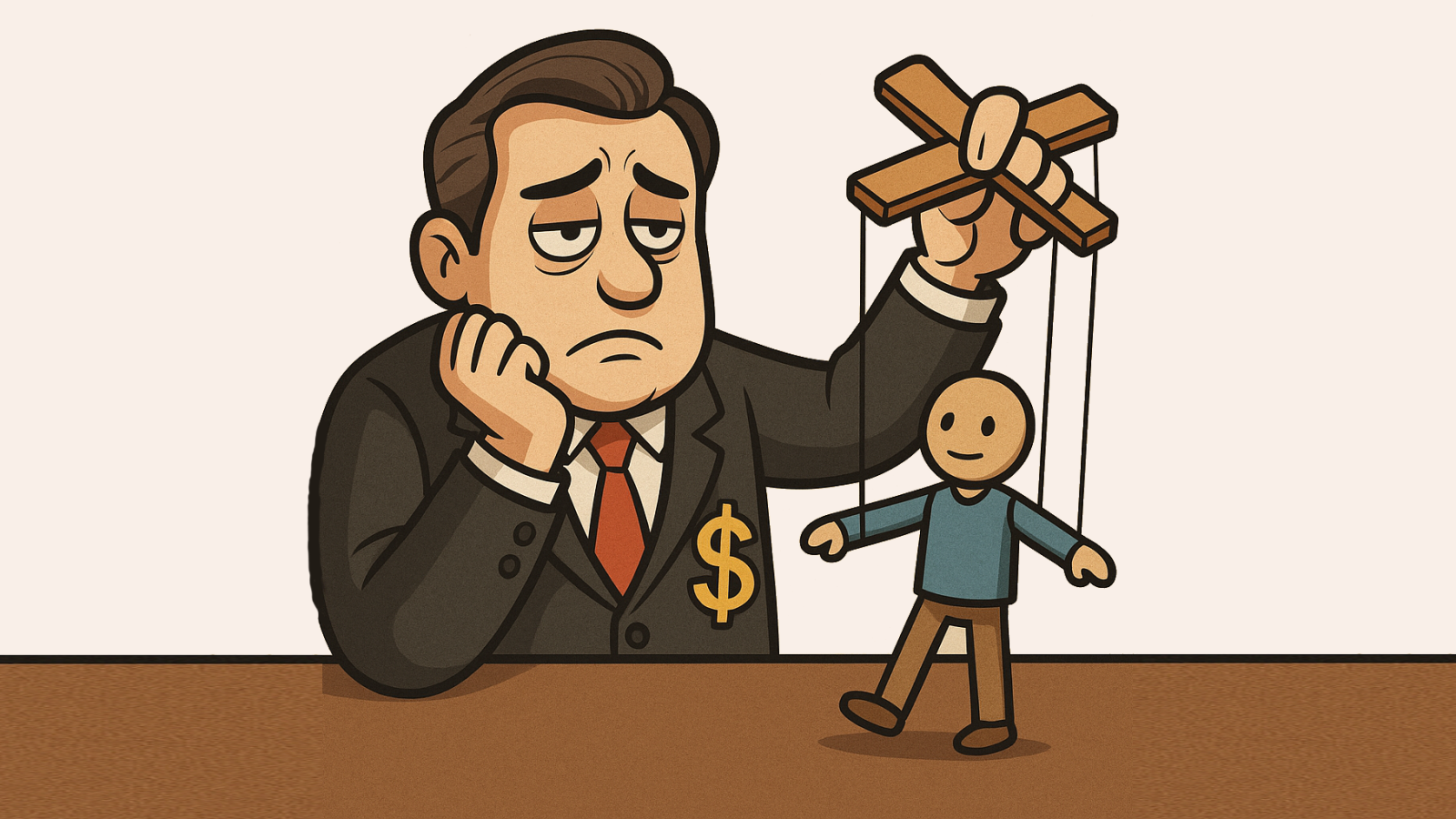
"Beware of bored billionaires."
~ Wisdom from my father
~ Wisdom from my father
Tempted though we might be to elaborate on the absurdity of determining a person's worth based solely on their ability to produce things other people want to buy (and are able to buy), that's for another day. Here, we need only point out that politicians from Reagan to Trump have marketed various iterations of Friedman's economic vision to the American public, which has mostly swallowed them whole.
Author James Greenberg summarizes the intersection of Friedman with state and national politics this way:
Friedman’s vision was radical not only in policy but in its moral frame. Government, he argued, should protect property, enforce contracts, and keep money stable. Everything else—schools, healthcare, social security, even disaster relief—was an intrusion. Public goods were reframed as private choices: education as a voucher, retirement as a personal account, disaster recovery as a business opportunity. Freedom, in this model, meant freedom for capital. It gave cover to roll back labor rights, weaken unions, and turn the state into a shield for wealth rather than a tool for sharing it.
~ ~ ~
As she researched recent private equity acquisitions that distort the missions of public-service organizations, and indeed destroy those organizations, author Megan Greenwell studied Friedman. She found it remarkable that, midway through his argument that CEOs are morally obligated to maximize profit, Friedman carved out one exception: for organizations such as hospitals and schools, which "will not have money profit as [their] objective but the rendering of certain services."
Thus, Friedman recognized the need for institutions whose primary goal must be not accumulation of wealth, but providing an essential, accessible public service. One of Friedman's greatest failings as an economic architect is that he did nothing with this important insight. The doctrinal primacy of business owners meant public service providers must exist within and navigate a private economy designed for them to fail.
Similarly, Friedman lacked follow-though on his recognition that private economic actors must operate within an ethical framework, which he called the "rules of the game" ... "open and free competition without deception or fraud." Friedman acknowledged the essential role government must play in upholding and enforcing the rules of the game, but left unexamined whether the Constitution grants government the authority to do so. Indeed, he never asked whether the Constitution even points in the right direction to enforce his rules. After all, enforcing Friedman's rules was never its primary purpose.
Friedman leaves us with no compensatory mechanism when private markets fail to make life-sustaining services available to the population, which they routinely do. Friedman asserts, in spite of ample evidence to the contrary, that gently-regulated markets will guard the public from abuse by the rich and powerful on their own.
The last two centuries have taught us that both unbridled capitalism and unbridled socialism lead to corruption and misery. In both models, power is concentrated, and freedom is demolished by concentrated power wherever it is tolerated. The private economy is a wealth engine necessary to sustain society, and it is a necessary component of personal liberty. But left unregulated, private economies run amok: chattel slavery, child labor, unsafe working conditions, monopolies, seven-day work weeks, racial and ethnic and gender discrimination, gross wealth inequity, pollution, bought and paid-for politicians.
The need for a smartly-managed, blended economy should not be a source of controversy in 2025. Nonetheless, here we are, widening the gap between haves and have nots with tax breaks for the wealthy while dismantling pubic services, all justified with the lie that our elected heroes are fighting socialism.
~ ~ ~
With the 2010 Supreme Court decision in Citizens United v. Federal Election Commission came the decisive blow in the political struggle between capital and ordinary Americans. In effect, capital itself was granted personhood, and unlimited amounts of money now flow into super PACs, which exercise almost total control over the election process right down to the municipal level.
Our government no longer bends to the will of the hyper-rich, it is the hyper-rich. And the hyper-rich don't care about ensuring that all of us have food to eat, clean water, places to live, ways to move from place to place, and access to medical care. Nor are they concerned with individual liberty and civil rights. We are witnessing wealth inequality not seen since the Gilded Age, public transportation systems in a death spiral, and healthcare systems collapsing.
Greenberg believes we are perched on the edge of an precipice, beyond which lies tyranny. He notes that oligarchic governments lose popularity as they damage lives and as the public realizes it has been deceived. (We are seeing the early signs of this in Trump's declining approval ratings.) Project 2025 has given the US experience a unique twist, the "fusion of market fundamentalism with culture war politics." The public is cleaved and distracted while repressive measures are forced into place:
The mobilization of National Guard units into civic roles, the growth of detention infrastructure, the steady expansion of executive power under the language of “emergency”—all of it builds the scaffolding needed to push through unpopular changes and contain dissent.
The swirl of chaos instigated by the executive branch and enabled by the legislative and judicial branches is cutting a path with but one destination. There is a shrinking window of time for Americans to recognize what's happening to us, and unless we do, we shall be well and fully and terminally screwed.
August 16, 2025
Israelis Are (Almost) All In on Genocide
Israelis Are (Almost) All In on Genocide
Israeli is starving and bombing Gaza to death. Only a small minority of Israelis think that's a problem.

A recent public Facebook post referenced this article, which offered the following sober assessment:
Israel’s decision to cut off all aid in March pushed the strip into the dire crisis it faces today. Israel said that it hoped the blockade would disrupt Hamas’s ability to profit from the goods coming in, weaken the group’s governance and pressure it to capitulate in cease-fire negotiations. This was not just a morally wrong choice — humanitarian aid should not be a political issue — but a strategically foolish one that misread both Hamas and the international community. A humanitarian catastrophe in Gaza was never going to force Hamas’s hand. The group needs very few resources to operate: just enough to continue to hold the hostages, carry out guerrilla attacks and continue making statements to influence public opinion.
The author of the post, Gili Getz, had this to say, and offered a different quote from the article:
Over the past three weeks, I've noticed a significant shift within the pro-Israel community in the U.S. largely due to the undeniable level of starvation caused by Israel and the decision to “occupy Gaza”. This shift will accelerate.
“When it comes to Gaza, Israelis live in an echo chamber, relying largely on local media, which often enacts self-censorship regarding Israeli wrongdoing and Palestinian suffering in Gaza. But it is also important to understand the powerful underlying emotions that have led many Israelis to close their eyes and ears to the suffering of Gazans and accept a different version of reality.”
Is there sad irony in the fact that the response from Israelis confirmed the thesis of the article? There was consensus in the comments around "finishing the job," annihilating Hamas entirely. Which led me to say:
To eliminate Hamas from Gaza, every living thing in Gaza would have to be destroyed. That wouldn’t end Hamas, just evict them from Gaza. Is that what you are advocating? Killing over one million children?
I got no response. But the tone of the conversation was that I was being unrealistic in seeking peace, the implication being that yes, starving as many people and killing as many children as is necessary to rip Hamas out branch and root is what must be done.
While surveys show total war is supported by only about 18% of Israelis, a majority are content to push their heads into the sand in one way or another. Ori Hanan Weisberg sums it up this way:
Ori said:
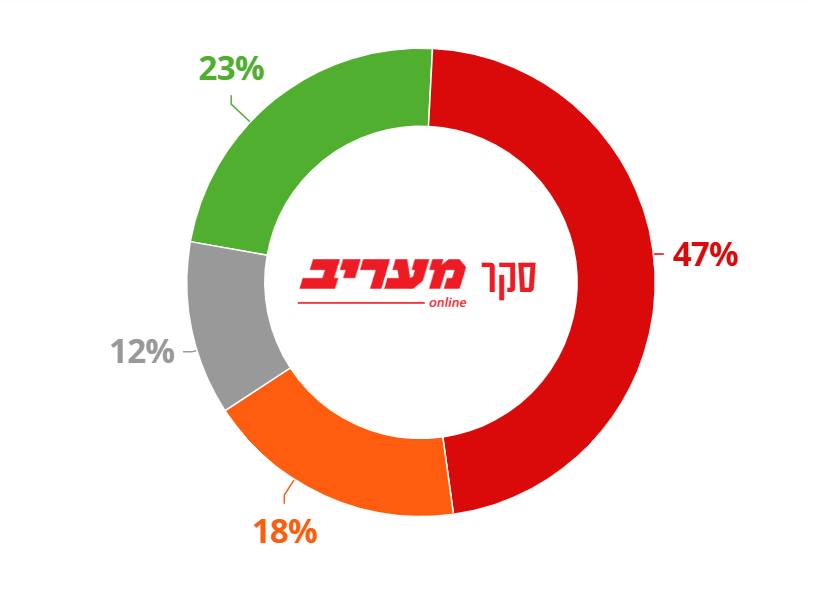
A follow-up to yesterday's post triggered (in all senses) by the Israel Democracy Institute's finding that 79% of Israelis are unconcerned about starvation/famine in Gaza.
Here is the graph of a poll from last week done by the Hebrew Ma'ariv daily newspaper on the subject:
Red (47%) - There's no famine and starvation in Gaza, it's all Hamas lies.
Green (23%) - There's famine and starvation and I care.
Orange (18%) - There's famine and starvation and I don't care.
Gray (12%) - No opinion
Ori goes on to say:
The denialists (47%), in my view, cannot be doing their due diligence. To say it's not happening at all is to deny mountains of evidence. The disengaged (12%) aren't better; in some senses they are worse. The first may plead media manipulation. The second only apathy, which I find perhaps the most damning. Atrocities don't occur without both denialism and disengagement.
Returning to the comment thread on Gili's post, this relevant exchange unfolded. A poster said:
You wouldn’t let Nazis roam around after WW2. It needs to end and we need to end them.
I pointed out that, in fact, Nazis were everywhere in Germany and beyond after WW2, including in the US. The commenter replied:
98% of Germans were Nazis. Are Palestinians 98% Hamas? Yeah maybe.
This mindset that we ought to kill 98% of Gazans but might not be able to serves to inhibit justice, not promote it. Yet there is a way forward, albeit one that requires cold calculation in place of hot, trauma-induced anger.
Only a maximum of 10% of Germans ever belonged to the Nazi party. Earning 37% of the vote in the Reichstag gave Nazis enough power for a full takeover. It’s more accurate to say the majority of the German population was complicit in allowing the Nazis to take over their country than to say that virtually all of them were Nazis.
In the last free election in Gaza, Hamas earned 40% of the vote and similarly took full control.
Evidence suggests that low-level complicity in enabling terrorists or genocidal sociopaths doesn’t make humans irredeemable. In World War II, a majority of Americans did not hold individual German citizens responsible for Nazi atrocities. As a rule, Nazi POWs on US soil were treated in accordance with the Geneva Convention. About 1% of the 400K POWs housed in the US found clever ways to stay after the war and eventually earned citizenship. Others returned to the US after being briefly repatriated. Treating Germans humanely paid dividends in helping to rapidly bury Nazism in Germany, to the extent that any viral, terroristic ideology can be buried.
In contrast, overly generous treatment of Confederate states in the aftermath of the Civil War led to traitors rapidly regaining political power in Washington, with which they killed off Reconstruction and enabled 100 years of Jim Crow violence and discrimination.
Given that these and many other robust historical models exist, a balanced, humane way to peace in Gaza might be found. Instead, Israel is well on its way to committing genocide in Gaza. Put that on Netanyahu and everyone who enables him, including the US. Without a major course correction, conflict in Gaza won’t end well for anyone, and won’t result in the security Israel strives for. And, by what means would Israel be rehabilitated after committing its own atrocity?
Postscript 1
One additional comment thread to unpack...
What about what Israel was doing to the Palestinians before October 7? Learn your history and it’s not your land.
This comment started out promisingly—there is much to discover by tracing history from Jewish immigration under British rule to present-day Gaza—then pivoted inexplicably and unhelpfully to the "it's not your land" argument of American progressives.
Gili issued this concise and civil retort:
It’s the land of both people. Don’t dehumanize and condescend here. I want this to end no less than you.
Another commenter traced the long Jewish history written into the land of present-day Israel, then said this:
The land belongs to both peoples and 2,000,000 Palestinians who enjoy living in a democratic state, as opposed to those in Gaza and the West Bank as well as Jordan.
Again, a promising start, but denigrating some Palestinians while praising others based solely on their current geographic location ignores Israel's complex historical connection to displacing Palestinians, creating problematic conditions for Palestinians in its immediate vicinity, and discrimination faced by Palestinians within Israel's borders.
Could common ground be reached were these two commenters to sit down with a regional map and history book?
Postscript 2
The ease with which both Hamas and Hitler rose to power as members of minority parties should give Americans great pause. Trump owns all three branches of government and earned a majority of the vote in 2024. His dictatorial inclinations are all full display and there is no sign that he will be brought to heel.
August 5, 2025
Person, Woman, Man, Progressive, Annoyance
Person, Woman, Man, Progressive, Annoyance
The het cis man / het cis woman cultural divide is hurting Democrats and helping Trump.
I'll get to the topic at hand in a moment. But first...
Is it possible that Democrats actually won in 2024, and "by a wide margin?" Almost anything is possible. In social media, conspiratorial hypotheses abound about tampering with the election count, fueled in part by Trump's clumsy statement that, for some, implies he knew of such tampering.
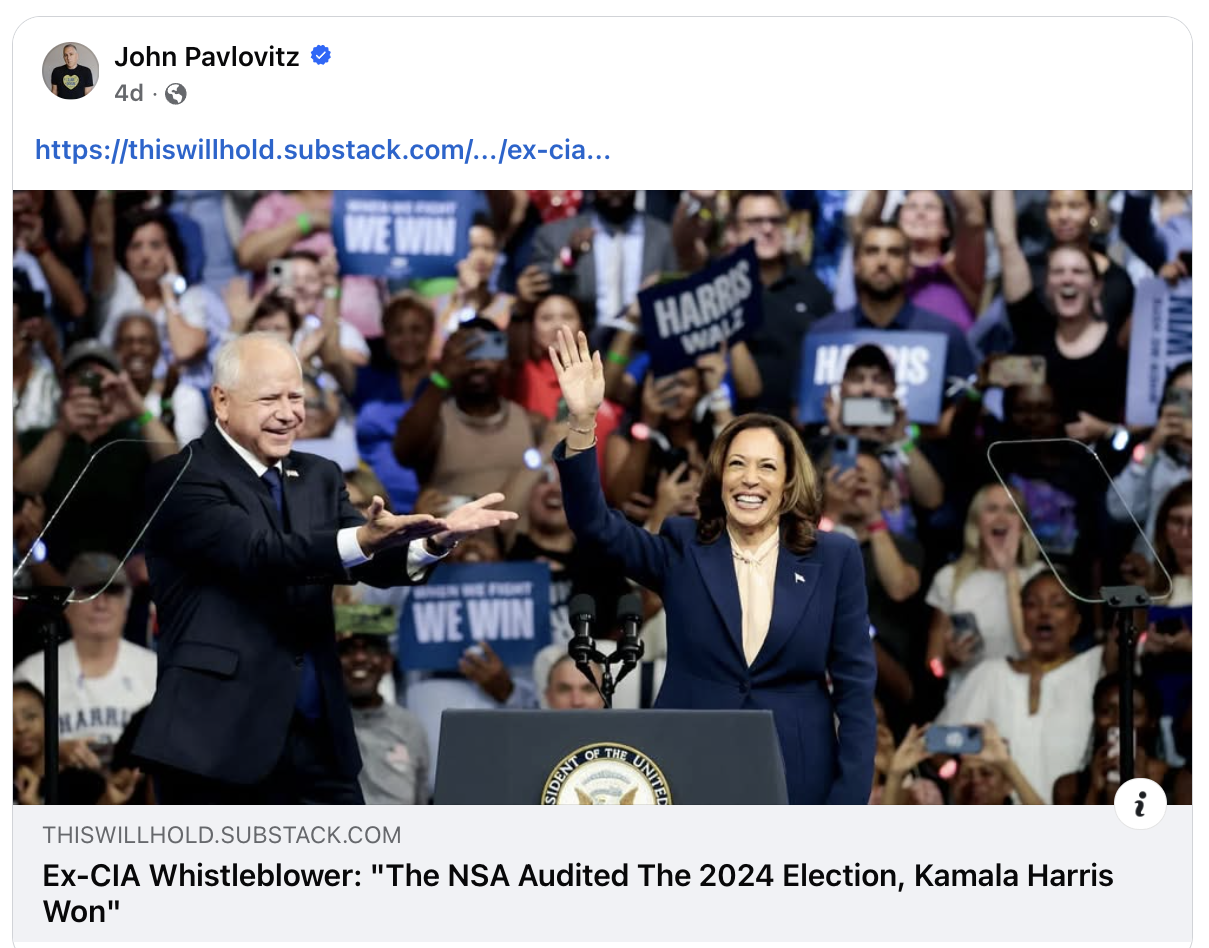
Conspiracy-minded Democrats are hanging their hats on Substack articles like this one to bolster claims that the 2024 election was stolen from them.

"[Elon] knows those computers better than anybody, all those vote-counting computers."
Trump speaks to supporters prior to his inauguration in 2025.
Of course, those inclined to believe this claim must also believe that a deep fake of multiple polls since the election has occurred. Those polls show that the Democratic Party remains less popular than the party of our adjudicated-rapist, convicted-felon president. Its own members see the Democratic Party as weak and ineffective.
Historical precedent, from both near and far into the past, buttresses the prediction that claims about the 2024 election being stolen, whether supported by evidence or not, will go nowhere. What will improve Democrats' chances in 2025, 2026, 2027, and 2028 is repairing the fractures within our party and constructing unifying messages which appeal to mainstream, heartland Americans. For affirmation, see: Bill Clinton of Arkansas, Barack Obama of Illinois; Joe Biden of Pennsylvania and Delaware. All of these winners crafted moderate platforms with broad appeal to Americans damaged (quite intentionally) by Republican policies.
Today, in the absence of a compelling Democratic leader with thoughts that don't involve resistance to Trump*, voters endure Trump's shock and awe media campaigns on one side and commentary from self-appointed progressive surrogates on the other. Too often, those surrogates veer into performative outrage over cultural trends. And no cultural battleground is more emblematic of how progressives hobble Democrats than the relational chasm between het cis men and het cis women.
*Pete Buttigieg, to his credit, is starting to message on picking up the pieces after Trump and what that may look like. Stay tuned.
Exploiters of the Man-Woman Divide Hurt Democrats and Help Republicans
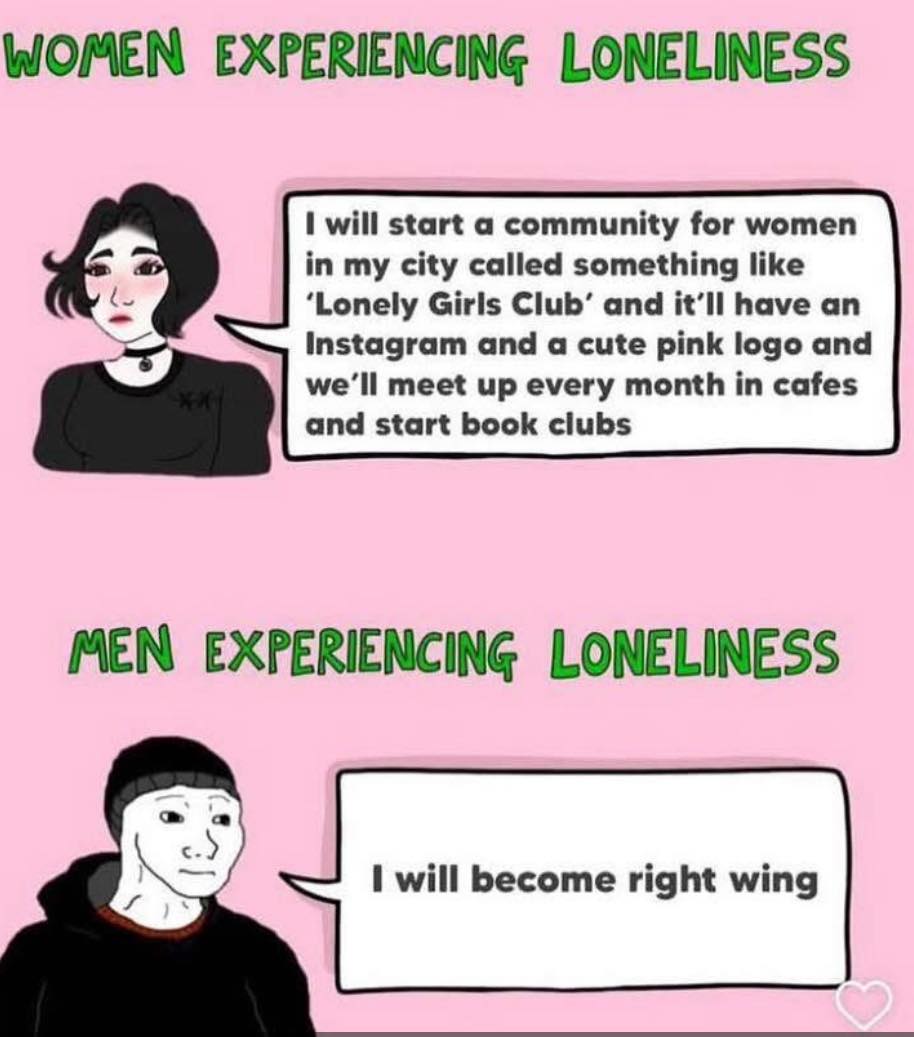
Various iterations on this basic progressive theme (women>men) are ubiquitous on the Internet, as are memes carrying the predictable right-wing backlash.
Perhaps some of those composing and posting these memes have given up hope of finding a political solution to our shared problems. Perhaps they are in it for the attention. Or perhaps they are stirring the pot to get more progressives to say the kinds of things that alienate male voters from the Democratic party.
Source: The Philosophers Boner, Facebook
Most het-cis men aren't incels. They aren't abusers. They aren't lonelier than the rest of humanity. And as voters, they are persuadable, given the correct messaging and underlying policy—which doesn't have to be MAGA horseshit to succeed. This meme and many others like it, with their broad condemnation of men, hurt Democratic politicians.
On the other side of the ledger, 52% of white women voted for Trump. They weren't bothered enough by men's behavior to pick a Black woman over an adjudicated rapist and convicted felon. Toxic femininity? Sure, if we're in the mood to alienate another persuadable group of humans.
~ ~ ~
My making statements like these on social media, uncontroversial though they ought to be in the face of relevant statistics, has been enough to send proud progressive keyboard warriors after me like wolves to red meat. For example, a Facebook friend posted the above meme, I commented, and her friend group ran through every white-woke-sanctioned talking point in response. As a typical man, I was "fragile," "whining," "unwilling to be held accountable," and had succumbed to "not all men" excuse-making. One person said I was abetting violence by men against women.
When I pointed out that white women broke for Trump, I got three responses. One, a commenter said many more men voted for Trump than women, so don't come for women. Two, a commenter inferred that white women were duped or cowed into voting for Trump by overbearing, violent white men. And three, what about non-white women? When I said that responses such as theirs were why I can no longer operate along side them as an activist in support of women—it's futile to align with a losing strategy—I was accused of leaving my granddaughter to suffer the consequences of Republican cruelties.
There is a staggering degree of political ineptitude revealed in these standard-issue progressive reactions. Should we be surprised that men gravitated to the party that held a seat open for them? (Tim Walz was too late and too muted to have the desired effect.) How incompetent must Democrats be when white women, a natural constituency in post-Roe America, broke for Trump? And how tragically clueless would it be to blend non-white women, who voted overwhelming for Harris, into the same demographic group as white women, merely to make things look better for women and for Democrats than they might otherwise look? The first step in persuasion is to know whom to persuade.
As the most reliable of Democratic voters, as someone who shares the humanitarian goals of progressives, and as someone who regularly calls out Republicans on their abundant horseshit, it's fascinating to me that I encounter more wrath from progressives than from MAGA cultists. As comedian Marc Maron has wryly noted:
Progressives have really gotta figure out how to deal with this buzzkill problem. I know these are important issues, but do you realize we annoyed the average American into fascism?
What the left does not understand, or does not care to know, is that posting a meme and commenting on a meme are political acts, whether intended as such or not. Some things are worth saying, consequences be damned. But not this dreck.
Marketeers Join In for Fun and Profit
Always down to gain some eyeballs from societal trends, advertisers in the US have started to dive into the man-woman ruckus. Gone are the days when a Super Bowl ad featured migrants at the Southern border wall to elicit sympathy with their travails, and increased sales of lumber. We now have Sydney Sweeney and her jeans/genes. The left went apeshit, the right mocked the left, and Trump couldn't resist chiming in. American Eagle's marketing team are very good at what they do.
The ad; performative outrage ensues on the left, and pushback on the right
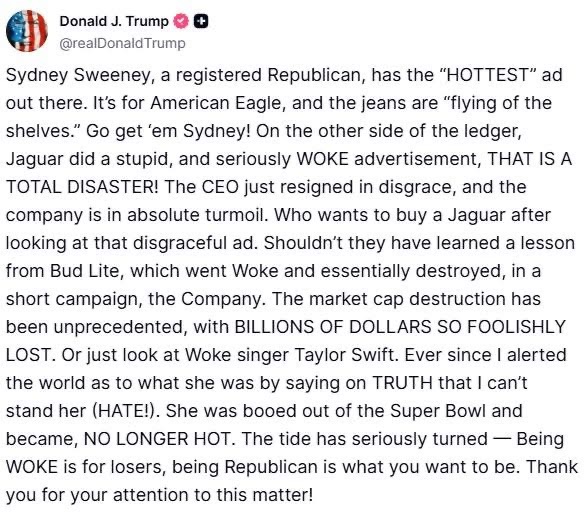
Trump chimes in, because of course he does

One can only hope that men's and women's relations soon start to heal. That day doesn't seem on the horizon though. The latest trends in my social feed are: (1) women, feeling burdened by all they are told to do to enhance their appearance, demanding that men do something about their balding heads, and (2) men mocking WNBA players for wanting to be paid more than the janitors in their arenas. We have descended into an emotional and spiritual desert of our own making.
SEARCH NEWS ITEMS
SEARCH ARTICLES
POSTS BY TYPE
POSTS BY TAG
POSTS BY MONTH