
Views from the Commons
Posts Filtered by Month - May 2026 |
Show Recent Posts
May 21, 2026
Who Would Congressman Bob Harvie Be?
Who Would Congressman Bob Harvie Be?
Brian Fitzpatrick's brand is forged. To win, Bob Harvie will need to forge a different and more appealing one.
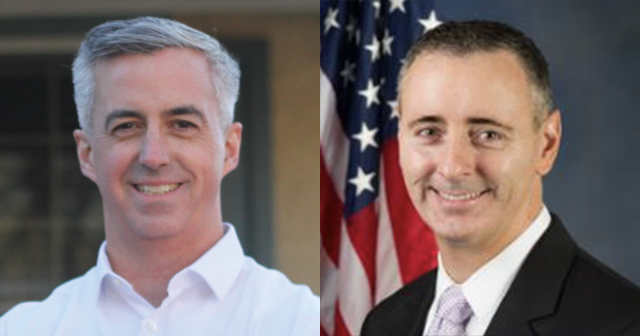
In yesterday's Democratic primary for congressional district PA-1, I cast my vote for Lucia Simonelli. Bob Harvie won by 2/3 to 1/3, which in my experience is the standard margin an endorsed Democratic candidate enjoys against a competent unendorsed candidate in Bucks County primary elections. I had no illusion going in: Lucia was bound to lose.
Most Bucks County Democratic voters, even those motivated enough to vote in an off-year primary, have done little or no research prior to appearing at the poll. They look at the "goldenrod" (the sample ballot of BCDC-endorsed candidates handed to them by Dem poll greeters) and vote for the names printed on it.
Should primaries work this way? I don't think so. But I don't blame BCDC. All political organizations are purpose-built to maximize their influence over elections. If voters allow them to use internal processes to drive electoral outcomes, they will.
Thus has Bob Harvie become the standard-bearer for Democrats in the general election.
Up to now, Harvie has spent a lot of time talking about Donald Trump. The words sound rehearsed, and designed in response to Trump's dismal polling. Trouble is, Harvie isn't running against Donald Trump, and Democratic polling numbers are dismal as well.
Relentless marketing over the past decade has severed Brian Fitzpatrick's brand from the MAGA movement. As he always does leading up to an election, Fitzpatrick will push back against Trump just enough to remind voters he is their "independent" congressman. Just yesterday, walking briskly and looking defiant, Fitzpatrick made national news as he announced opposition to Trump's fund for victims of DOJ overreach. The timing of that interview was no accident.
My advice to Harvie, unsolicited and probably unwelcome:
- Recognize the primary was a coronation. The general will be a dog fight.
- Too much focus on Trump is poor marksmanship.
- Stand for something. "I'm not MAGA" isn't policy. Don't count on midterm backlash against the party in power—even a party as fecal as the current one.
- Create space between you and Fitz. Right now, voters are looking at two conventionally attractive, middle-aged, politically moderate white men. The resting intellectual state of independents and moderate Republicans will steer them toward the Fitz status quo. If you don't upset the apple cart, you will lose.
- Study what it means to be a congressperson, and define your role. In the candidate forum, you expressed no desire to serve on any particular committee. Seriously? Articulate your goals. Identify committees aligned with those goals. Tell voters what you want do and how you intend to do it. In other words, do what Lucia Simonelli did in her doomed campaign against you.
- Be yourself. Don't let DCCC, PA Dems, or BCDC define you. They will push you into a formulaic mold that will guarantee failure in November. I've been studying you since you got elected as Bucks Commissioner, and I still don't know who your are. I'm guessing that who you are is head-and-shoulders better than who Fitz is. Make sure we all know it.
- Speak in plain language. Study Trump's speech patterns. They work. Employ them for good, not evil.
In November, the goldenrod will mean nothing. To pry votes away from Brian Fitzpatrick, Bob Harvie will need to have established an identity as a future congressperson voters like more than they like Fitzpatrick.

May 20, 2026
Trump-Speak: Worth Studying
Trump-Speak: Worth Studying
What Trump says is divisive, inflammatory, misleading, demeaning, fear-mongering, scapegoating, norm-eroding, and destabilizing. How he says it is worth studying.
I asked Claude, "Analyze Trump's vocabulary in public speech from a linguistic point of view." Here's what Claude said, with annotation. Democratic candidates, take note.
Trump's public speech is one of the most studied political idiolects of the past decade, and linguists have converged on a fairly stable set of features. A few of the more well-documented ones:
Lexical simplicity and Anglo-Saxon core vocabulary. Multiple readability analyses (Carnegie Mellon's Language Technologies Institute did a widely-cited one comparing presidents) place his speech around a fourth- to sixth-grade Flesch-Kincaid level—lower than any modern U.S. president measured. The mechanism is concrete: he favors short Germanic-root words ("bad," "weak," "big," "smart," "guy") over Latinate or polysyllabic alternatives ("detrimental," "feeble," "considerable," "intelligent," "individual"). This isn't a deficiency in itself; plain Anglo-Saxon vocabulary is a recognized persuasive register, used to similar effect by FDR and Reagan. It does, however, lower the cognitive load and signal in-group identity.
Fourth- to sixth-grade vocabulary is probably the correct target for public speech, as is minimizing the syllable count of words. Don't sleep on Claude's name check of FDR here. "The only thing we have to fear is fear itself"—perhaps FDR's most memorable quote—is straight out of the Trump register. The difference is, it signals inclusivity, and provides an example of how TrumpSpeak can be adapted to Democratic values.
Hyperbolic intensifiers and superlatives. "Tremendous," "incredible," "beautiful," "fantastic," "horrible," "disaster," "disgrace"—a small evaluative vocabulary deployed at very high frequency. Almost everything sorts into a strongly positive or strongly negative bin, with very little neutral or hedged middle. Constructions like "the greatest in history," "like nobody's ever seen," "nobody knew," and "in the history of our country" turn ordinary statements into superlative ones. Jennifer Sclafani's sociolinguistic study (Talking Donald Trump, 2017) treats this as central to his stylistic identity.
Manichaean framing. People and things are labeled as winners/losers, strong/weak, smart/stupid, beautiful/disgusting, real/fake. The lexicon itself does much of the argumentative work because the evaluative axis is built into the word choice rather than reasoned out in subordinate clauses.
This Democrat has been hungry since 2016 for the our candidates to turn the tables on Trump's Manichean framing. We go after Trump, but in moral terms, which just makes us sound sanctimonious and whiny. Instead, we should sound like Trump, as we go after MAGA for what they are doing to our country. Keep to the same dozen or so words. Focus on bad things moderates can see with their own eyes. MAGA leadership has truly been weak, stupid, disgusting, and fake. Make sure everyone knows it.
"MAGA healthcare is a disaster. Democrats will clean up the mess and do it very quickly."
Epistemic hedging that paradoxically amplifies. "Many people are saying," "a lot of people don't know this," "I've been hearing," "some say." These look like hedges but function rhetorically as appeals to anonymous consensus—they import an unattributable crowd as a witness. Paired with "believe me" and "frankly," they create a structure where the speaker can advance a claim without owning it and have it sound widely held at the same time.
Let's not wait for doing the right thing to become popular. Let's speak as though it already is, and let the public catch up.
Paratactic syntax and the "weave." His sentences tend to be short, coordinated by "and" or simply juxtaposed, rather than embedded with relative clauses and subordinators. Mid-utterance topic shifts (anacoluthon) are frequent—he begins a syntactic structure, abandons it, picks up a new one. Linguists have noted this isn't random: he often loops back to earlier topics, a digressive but cyclical pattern he himself has called "the weave." This resembles oral storytelling traditions more than written political rhetoric.
Repetition for emphasis. Reduplication ("very, very," "big, big," "many, many"), tricolons ("we will win, we will win, we will win"), and refrains. This is ancient rhetorical machinery—Cicero would recognize most of it—but heavily used.
Democrats are good at storytelling—to a point. Their stories are too linear, too focused, and too scripted. It's fine to organically "weave" a message you want to repeat into an answer about something completely different. We've seen that the public forgives and even enjoys such meanderings when they are spontaneous and not rehearsed.
Nicknaming as compressed argument. "Crooked Hillary," "Sleepy Joe," "Lyin' Ted," "Little Marco." Each is a portable, memorable epithet that bundles a claim into a name, so that every subsequent mention re-asserts the attack without needing to argue it.
When Democrats try to do this, it falls flat. Grade school taunts aren't in Democrats' DNA.
Apophasis (paralipsis). "I'm not going to mention…," "I won't even bring up…"—a classical figure for asserting something while disclaiming the assertion.
Use when appropriate, and only organically.
Branding register. His vocabulary draws heavily from advertising and real-estate marketing: "the best," "luxury," "tremendous," "deal," "winner." The slogan-form ("Make America Great Again," "Drain the Swamp," "Build the Wall") imports product-positioning conventions into political discourse—short, imperative or declarative, alliterative or rhythmic.
As Louis CK said, teachers have to make kids learn math against their will. How do they do that? Salesmanship. a Too often, Dems assume their talking points are so self-evidently awesome that linguistically laying them out on the table is enough. Meantime, Trump convinced a big chunk of the US population that he won an election he lost by millions of votes.
Pronoun patterns. High first-person singular ("I") combined with a strongly bounded "we" and an antagonistic "they." Corpus studies have noted his "I" rate is unusually high for political speech of this scale, contributing to a personal, conversational feel.
My English teachers taught me to avoid "I" sentences. My English teachers were wrong. Starting a sentence with "I" conveys power and ownership, especially when the "I" is paired with an action verb. "I will fix the mess Trump has created."
My English teachers taught me to avoid "I" sentences. My English teachers were wrong. Starting a sentence with "I" conveys power and ownership, especially when the "I" is paired with an action verb. "I will fix the mess Trump has created."
Tag forms and discourse markers. "Right?", "OK?", "believe me," "you know"—features of conversational rather than oratorical register. They invite the audience into a position of tacit agreement.
As I write this, I am listening to Trump lie. In the middle of his sentence, he inserted "as you know." What a brilliant diffusion, a dulling of the sharp edge of a dishonest statement.
Barack Obama recently asked of Democrats, "Do you know how to just talk to regular people like we’re not in a college seminar? Can you talk in plain English to folks?" There is the echo of an unspoken "Right?" at the end of this sentence. Obama won in 2008 in no small part because he had mastered the art of oral persuasion. Only after having been elected did he, defensively and under stress, retreat to the haughty vernacular of his Harvard birthing ground.
Claude summarized its response by characterizing the features of Trump's speech in both positive and negative terms: rich in the tools that oral persuasion has used for millennia, yielding high memorability and emotional engagement, but also vague, low-information, and resistant to fact-checking. My assessment is more blunt. Trump has elevated making false and misleading statements to a fine art. Democrats don't need to lie to shape their speech in more relatable terms. The hallmarks of TrumpSpeak—simplicity, repetition, concrete words, evaluative binaries, and conversational tags—are also available to those telling the truth.
May 18, 2026
Lucia for PA-1
Lucia for PA-1
Tomorrow, I'm voting for the most qualified, most authentic, and most promising candidate to take on Brian Fitzpatrick. It's not Bob Harvie.
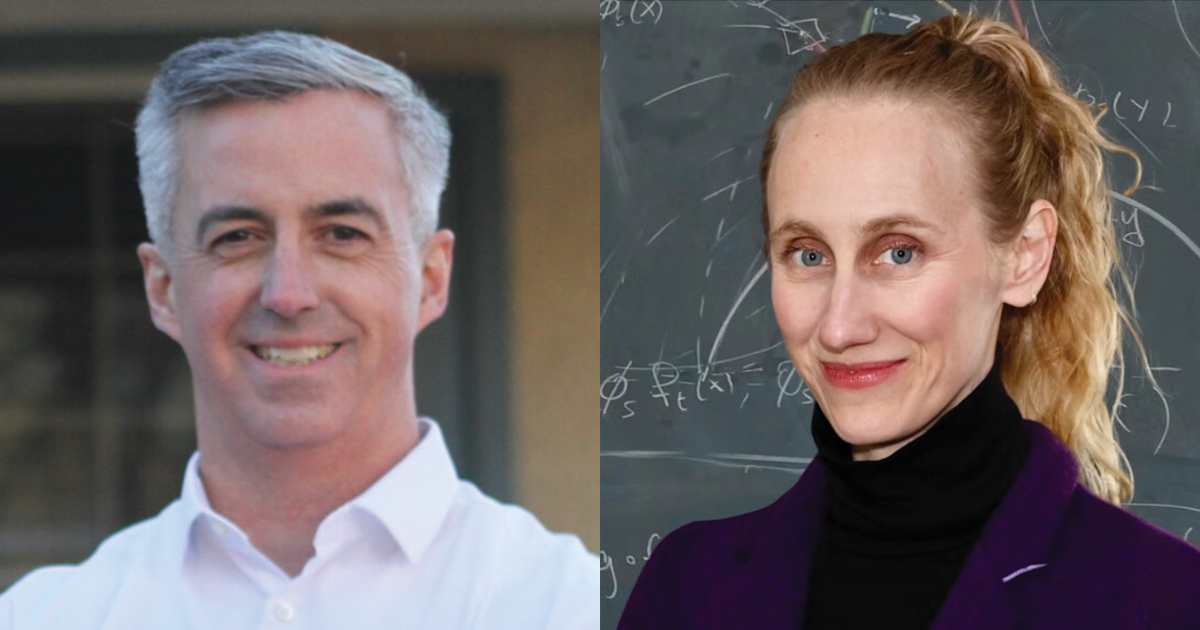
Bob Harvie and Lucia Simonelli, Democratic candidates for Congress in PA-1. The winner will take on Brian Fitzpatrick in November's general election.
Dubbed the person most likely to beat Fitzpatrick, Harvie has enjoyed quite the Dem-orchestrated glide path. Harvie announced his candidacy just a few months after the 2024 general election. Democratic leadership pressed the electability case from start to finish. On announcement day, Bucks County Dem chair Steve Santarsiero told WHYY Harvie had "a real chance to win," and fourteen months later, on the eve of the primary, DCCC Chair Suzan DelBene called him "the strongest candidate to take on Brian Fitzpatrick"—a through-line that included endorsements from committeepersons and Governor Josh Shapiro.
Timed to have maximum impact on the primary, Harvie was added to the DCCC's Red to Blue program on May 4. Shapiro's endorsement followed on May 10.
Harvie himself has embraced the electability messaging. Referencing his two victories in county commissioner races, Harvie said: "How will I get Republicans to vote for me? I already have."
Harvie supporters push back against the "establishment candidate" label. But if ever there was an establishment candidate, Harvie is it. Party leaders picked their winner more than a year before voters will have the final say. And tomorrow, his name will be the only one on the "goldenrod" sample ballot provided to voters by Democratic poll greeters.
The trouble with the claim that Harvie is the best candidate to beat Brian Fitzpatrick? Lucia Simonelli, the other congressional candidate on the Democratic ballot.
In contrast to Harvie, Simonelli has spent almost no time talking about Donald Trump and Brian Fitzpatrick. Instead, she has laid out, in detail, her vision for how government can work on behalf of the citizens of PA-1:
- Environmental protections and clean energy
- Universal health care
- Restoration of government-sponsored science
- Supports for veterans, farmers, blue-collar workers, and practical education
- Higher taxes on billionaires
- Getting rid of ICE and starting over
Simonelli has shaped public policy as senior staffer for Senator Sheldon Whitehouse (D-RI), and for nonprofits. She holds a doctorate in mathematics. Simonelli is book smart, and a policy wonk. Nonetheless, she is able to articulate and defend her positions in plain language and without jargon. I find her speeches punchy and compelling.
In the April 27 candidate forum documented here, the differences in substance and style of the two candidates could not have been clearer. Yes, they share broad agreement on important issues: keeping dark money out of politics, childcare, raising the minimum wage, abortion, tax-code fairness, districting by independent commission, and the importance of trade schools, among others. But I found Simonelli's crisp, spin-free, unabashedly progressive delivery more appealing than Harvie's cautious tone, which too often seemed designed more to avoid alienating moderate voters than to clearly define his intentions. Harvie's response on healthcare, including the statement that "America is not ready for universal healthcare," was especially awkward and squishy. In several key exchanges, Harvie, the career politician, scrambled to catch up, as Simonelli rattled off positions and proposals.
Bob Harvie is a team player treading the moderate Democratic party line. He struggles to project passion and purpose. He was able to earn Republican votes in off-year elections against Trumpy opponents. Can he steal Republican votes from Brian Fitzpatrick? Given that voters perceive Fitzpatrick as low-key, moderate and independent, they may regard Harvie as the Democratic equivalent, not worth a split ticket. The more Harvie hedges on major reforms to systems like healthcare, the less space between him and Fitzpatrick he creates.
There is no doubt Lucia Simonelli can effortlessly create such space. But Simonelli is a progressive, and relatively unknown in Bucks County. Are those fatal liabilities? Conventional wisdom says yes. I'm not so sure. Simonelli's singular focus on improving the lives of those she would represent, and her fearlessness in stating the exact ways she would do so, are refreshing. With gas approaching $5 a gallon, voters may be more drawn to Simonelli's relentless positive energy than put off by her progressivism. As to name recognition, that depends largely on how much money Democrats are willing to spend on her campaign should voters topple their apple cart.
Tomorrow, Democratic voters in PA-1 will choose between a candidate their party has carefully groomed and guided to this moment, and a candidate who arrived on her own terms, armed with ideas and the confidence to defend them. Whatever happens, Lucia Simonelli has spoken powerfully from a platform she created, one the Democratic party tried hard to demolish. That in itself is an accomplishment worth celebrating.
SEARCH NEWS ITEMS
SEARCH ARTICLES
POSTS BY TYPE
POSTS BY TAG
POSTS BY MONTH