Views from the Commons
Posts Filtered by Tag - Public Policy |
Show Recent Posts
September 16, 2025
Without Economic Justice, Freedom Dies
Without Economic Justice, Freedom Dies
Capitalism unleavened by social pragmatism leads to misery and repression. Last in a series of two articles.
Last time, I gave a crash course on Milton Friedman and how his philosophy of the economy has been exploited and corrupted by government and private actors for their own gain, to the detriment of the general population.
In Friedman's limited government scheme, not even tender mercies remain for those who, through no fault of their own, struggle to produce things other people want to buy, or are able to buy. Determination of a person's worth based only on how others value their productivity in the present is nonsensical on its face. How much human genius was only recognized after the death of its author? What about the dynamic mismatch between supply and demand in the job market? And what's to become of those suffering from disabling injury or mental illness which prevent them from producing anything at all? While the free market is a highly effective wealth engine, we've seen time and again that it is profoundly incapable of addressing human problems most of us care about.
A private economy—the free exchange of value for value—is necessary in a free society, but insufficient to meet all of its needs. (That there is debate around whether food, clean air and water, inexpensive transportation, housing and medical care are genuine needs, and that self-identified Christians are refuting that they are, shocks the conscience.) Organizations that render essential services at below-market prices, services essential to the wellbeing of poor Americans, cannot survive in Friedman's scheme. Suffering and premature death are features of laissez faire capitalism, not bugs. Government must fill the gaps. Nothing else will, certainly not private charity.
~ ~ ~
Coming at an apex of economic justice in America, a triumph centuries in the making, Friedman's manifesto told us to throw it all away.
We had vanquished slavery and child labor, invented retirement without poverty and disease, ended Jim Crow and its destruction of Black Americans' generational wealth, expanded access to medical care for seniors and the poor, earned the right to unionize, and spawned the middle class. We were on the road to eliminating the military draft and its discriminatory focus on poor and uneducated men. The feminist movement had started the process of moving toward gender equality in the economy.
All of these gains, earned through the blood, sweat and tears of soldiers, laborers and protesters, were codified through legislative action: the 13th, 14th, 15th, and 19th amendments, the New Deal, the Civil Rights Act, along with many lesser known pieces of legislation.
Then, in the 1970s, everything changed. Economic and cultural upheaval ripped asunder the coalition of left-wing activists and blue-collar workers comprising the Democratic base. Republicans sensed an opportunity to cleave White working class Democrats from their party. They characterized left-wing activists as anti-American lunatics and abortion as murder. Invoking Friedman, they claimed that entitlements make people lazy and diminish the value of hard work.
The strategy succeeded. White working-class Democrats with moderate or conservative social viewpoints switched to the Republican party in droves.
As Republicans have built their new coalition, Friedman has continued to serve them in multiple ways. The limited role for government he envisioned provides justification for ending any economic or social program Republicans don't like, no further discussion needed. Meantime, Republicans attack liberty delivered by the courts, in the form of Roe v. Wade, Obergefell v. Hodges, or stays to unconstitutional administrative orders, as judicial activism.
Once the Republican Party's simple message of small government, low taxes, and patriotism was internalized by the electorate, it became easier and easier to ignore that Friedman had argued, above all, for personal freedom. As Republicans have chased the support of various interest groups, their guiding principles have morphed from laissez faire individualism to Christian theocracy, nativism, authoritarian power housed in the executive branch, partisan law enforcement and prosecution, denial of science, denial of election outcomes, and more—all the bad things the Founders had attempted to shield us against.
And, as it would not serve their objectives to do so, Republicans have never reduced the size of government, only redirected it in detrimental ways.
~ ~ ~
Consider the admonitions of libertarians that we cannot and should not wish away debilitating scarcity by clicking our heels three times (or by establishing a government program).
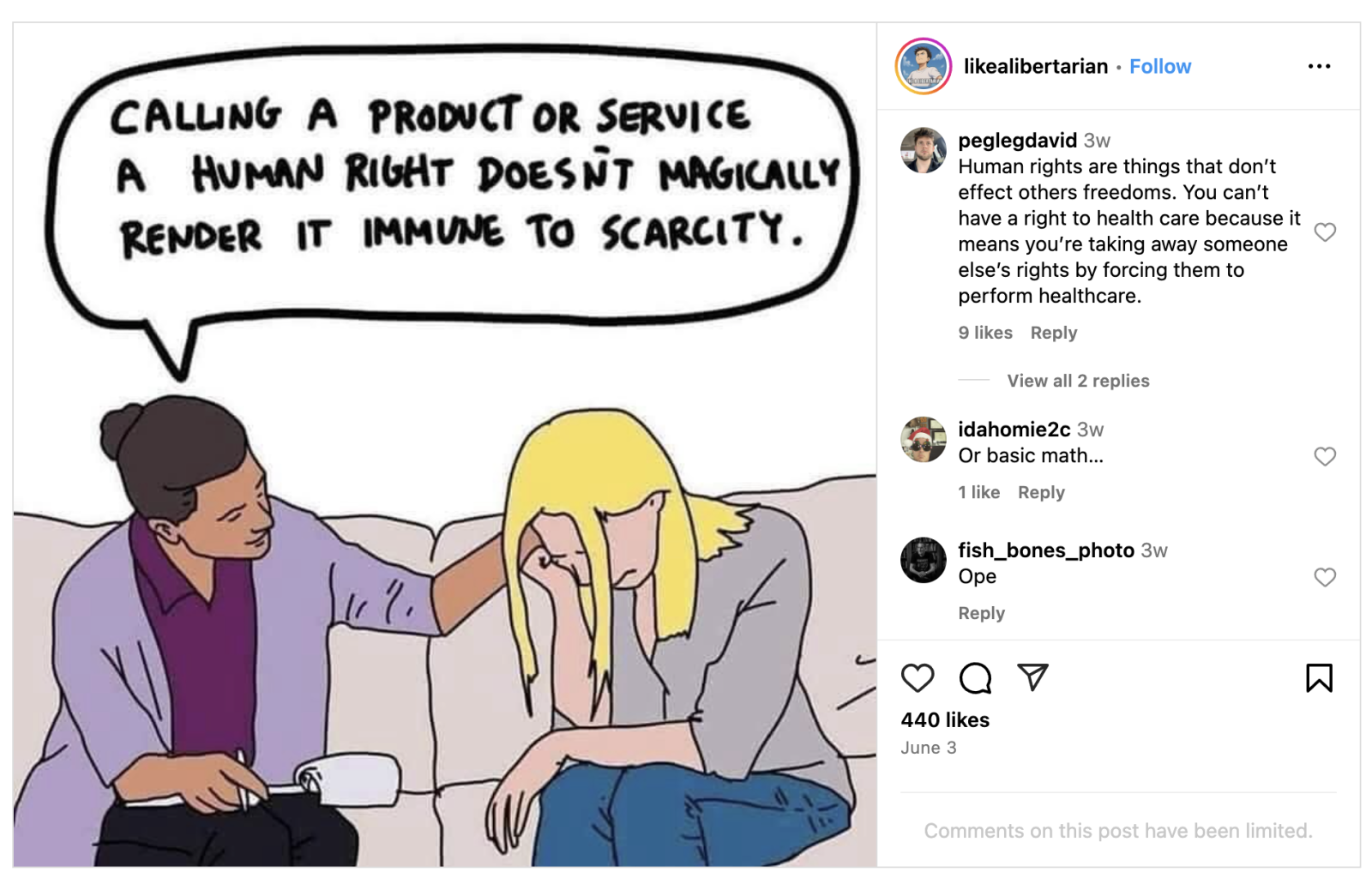
Let people die of preventable things, just don't disrupt the purity of my philosophic beliefs.
This flavor of libertarianism is horseshit. Occasionally, an existential threat appears to remind us that ideological purity is 100% aspiration and 0% practicality. When such a crisis flares up, we stop what we're doing, start shoveling, and keep it up until the fire is out. In a recent example, public-private partnerships developed COVID-19 vaccines and brought a brutal pandemic to heel. Should we listen to the crazies and not develop a vaccine the next time around? RFK Jr. wants us to do exactly that.
No doubt, government made deadly mistakes in its response to COVID-19. In the aggregate though, the response saved millions more lives than it cost.
It's no accident that the MAGA propaganda engine is firing on all cylinders to paint the entirety of our COVID-19 mitigations, including vaccines, as left-wing overreach. Community, regional, and federal co-operation distributes power Trump and his enablers want to consolidate in the Oval Office. Trump burns so intensely for power, he is willing to toss his greatest accomplishment in public life, facilitating the development of COVID-19 vaccines, into the bonfire.
Libertarians think taxation is theft. Sometimes, it is. But a robust private economy depends upon public projects which the private economy is often not interested in pursuing: Roads, bridges, railroads, power infrastructure, and electronic networks required to make commerce possible, and wide distribution of water, food, housing and healthcare required to keep workers healthy.
~ ~ ~
It's the nature of individual liberties to bump into each other. Civil jurisprudence comprises adjudications, healing of the literal or figurative bruises formed whenever freedoms and rights collide. In other words, no right is absolute. But rights ought not be tossed out because conditions apply to them. For example, if we can design a healthcare system with fewer unnecessary deaths, at a cost society can bear, shouldn't we do it? As we aspire to let free markets solve all our problems, should we not step in, by altering the legal framework of the private economy and with public service programs, when markets fail and people are dying?
Instead, we witness first-hand the dangers of economic and theocratic ideology twisted to serve the powerful at the expense of the general population. Enabled by the lie that government is universally wasteful and ineffective and the bizarre claim that mercy is "woke," essential supports, reliefs, and safeguards are being stripped away: consumer and environment protection, Medicaid, USAID, vaccine research, public broadcasting, voting rights, the Posse Comitatus Act, neutral courtroom justice, due process, disaster response and more, all weakened or eliminated. As right-wing violence escalates, Trump decries "radical left-wing lunatics" as pretext to "root them out" in dictatorial fashion. And Trump is just getting started.
It can seem as hopeless as trying to stop the rain, but we must rise up to diffuse this particular storm or it will drown us.
August 25, 2025
The Oligarchy of the Present Explained in Plain Language
The Oligarchy of the Present Explained in Plain Language
The short path from a fair playing field for the private economy and its laborers to oligarchic rule by a few bored, hyper-rich sociopaths
We begin with Milton Friedman and his outsized influence on American politics from the 1960's to the present. In a 1970 New York Times article, Friedman outlined his thoughts on economic systems; the article is as quick and informative a read as any.
Friedman viewed the private economy as a blunt instrument designed to do what the owners of businesses want, which, in almost all cases, is to make as much money as possible. Under Friedman's scheme, it's the sole job of government to protect the private generation and accumulation of wealth, by providing for the national defense and by enforcing contracts. Friedman spent his career railing against what we now call the deep administrative state, which, he believed, had made just about everything it touches worse. Left to their own devices, Friedman claimed, free markets will set individuals free and suppress hate-fueled violence, as they only care "whether [people] can produce something you want to buy."
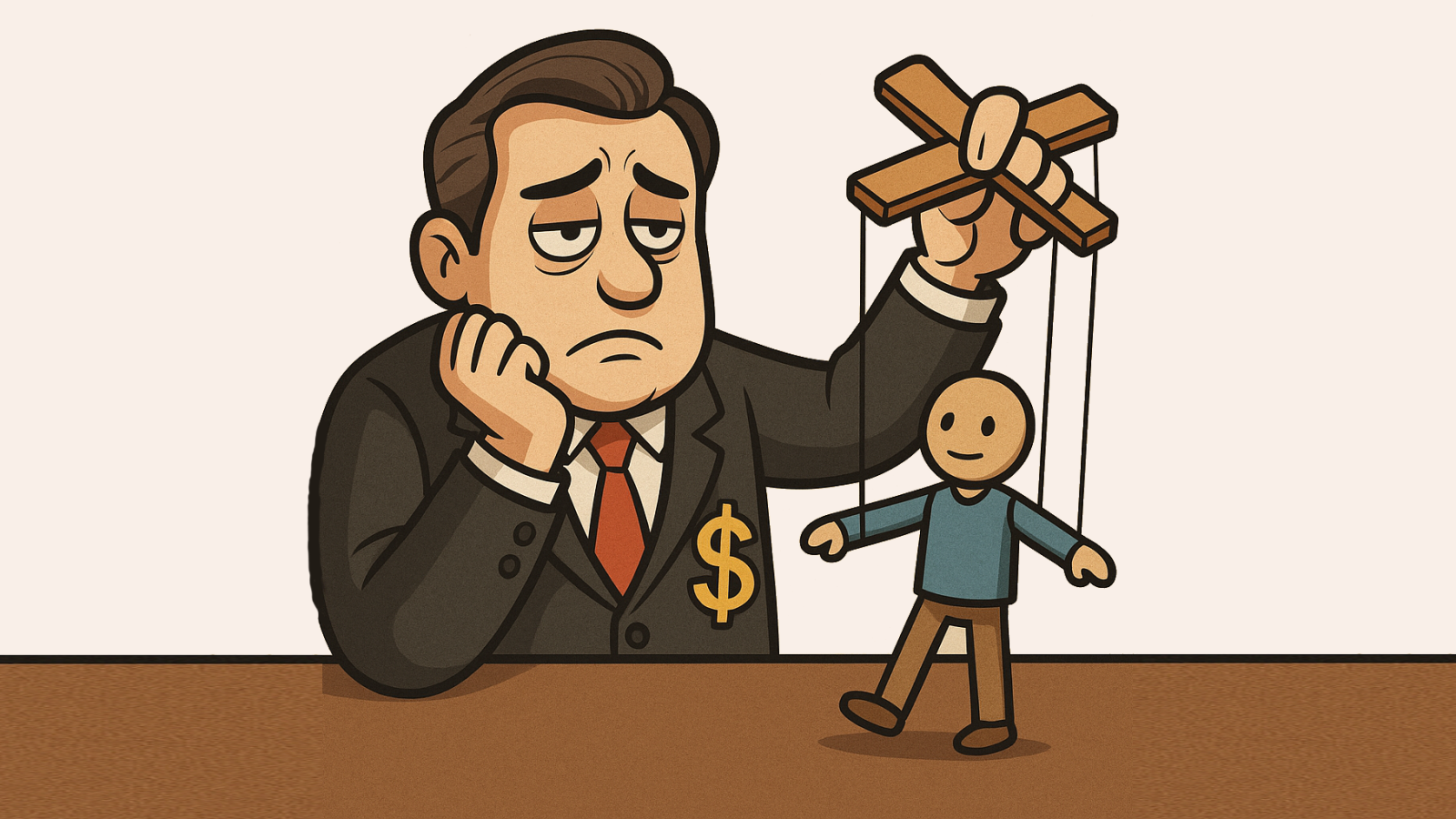
"Beware of bored billionaires."
~ Wisdom from my father
~ Wisdom from my father
Tempted though we might be to elaborate on the absurdity of determining a person's worth based solely on their ability to produce things other people want to buy (and are able to buy), that's for another day. Here, we need only point out that politicians from Reagan to Trump have marketed various iterations of Friedman's economic vision to the American public, which has mostly swallowed them whole.
Author James Greenberg summarizes the intersection of Friedman with state and national politics this way:
Friedman’s vision was radical not only in policy but in its moral frame. Government, he argued, should protect property, enforce contracts, and keep money stable. Everything else—schools, healthcare, social security, even disaster relief—was an intrusion. Public goods were reframed as private choices: education as a voucher, retirement as a personal account, disaster recovery as a business opportunity. Freedom, in this model, meant freedom for capital. It gave cover to roll back labor rights, weaken unions, and turn the state into a shield for wealth rather than a tool for sharing it.
~ ~ ~
As she researched recent private equity acquisitions that distort the missions of public-service organizations, and indeed destroy those organizations, author Megan Greenwell studied Friedman. She found it remarkable that, midway through his argument that CEOs are morally obligated to maximize profit, Friedman carved out one exception: for organizations such as hospitals and schools, which "will not have money profit as [their] objective but the rendering of certain services."
Thus, Friedman recognized the need for institutions whose primary goal must be not accumulation of wealth, but providing an essential, accessible public service. One of Friedman's greatest failings as an economic architect is that he did nothing with this important insight. The doctrinal primacy of business owners meant public service providers must exist within and navigate a private economy designed for them to fail.
Similarly, Friedman lacked follow-though on his recognition that private economic actors must operate within an ethical framework, which he called the "rules of the game" ... "open and free competition without deception or fraud." Friedman acknowledged the essential role government must play in upholding and enforcing the rules of the game, but left unexamined whether the Constitution grants government the authority to do so. Indeed, he never asked whether the Constitution even points in the right direction to enforce his rules. After all, enforcing Friedman's rules was never its primary purpose.
Friedman leaves us with no compensatory mechanism when private markets fail to make life-sustaining services available to the population, which they routinely do. Friedman asserts, in spite of ample evidence to the contrary, that gently-regulated markets will guard the public from abuse by the rich and powerful on their own.
The last two centuries have taught us that both unbridled capitalism and unbridled socialism lead to corruption and misery. In both models, power is concentrated, and freedom is demolished by concentrated power wherever it is tolerated. The private economy is a wealth engine necessary to sustain society, and it is a necessary component of personal liberty. But left unregulated, private economies run amok: chattel slavery, child labor, unsafe working conditions, monopolies, seven-day work weeks, racial and ethnic and gender discrimination, gross wealth inequity, pollution, bought and paid-for politicians.
The need for a smartly-managed, blended economy should not be a source of controversy in 2025. Nonetheless, here we are, widening the gap between haves and have nots with tax breaks for the wealthy while dismantling pubic services, all justified with the lie that our elected heroes are fighting socialism.
~ ~ ~
With the 2010 Supreme Court decision in Citizens United v. Federal Election Commission came the decisive blow in the political struggle between capital and ordinary Americans. In effect, capital itself was granted personhood, and unlimited amounts of money now flow into super PACs, which exercise almost total control over the election process right down to the municipal level.
Our government no longer bends to the will of the hyper-rich, it is the hyper-rich. And the hyper-rich don't care about ensuring that all of us have food to eat, clean water, places to live, ways to move from place to place, and access to medical care. Nor are they concerned with individual liberty and civil rights. We are witnessing wealth inequality not seen since the Gilded Age, public transportation systems in a death spiral, and healthcare systems collapsing.
Greenberg believes we are perched on the edge of an precipice, beyond which lies tyranny. He notes that oligarchic governments lose popularity as they damage lives and as the public realizes it has been deceived. (We are seeing the early signs of this in Trump's declining approval ratings.) Project 2025 has given the US experience a unique twist, the "fusion of market fundamentalism with culture war politics." The public is cleaved and distracted while repressive measures are forced into place:
The mobilization of National Guard units into civic roles, the growth of detention infrastructure, the steady expansion of executive power under the language of “emergency”—all of it builds the scaffolding needed to push through unpopular changes and contain dissent.
The swirl of chaos instigated by the executive branch and enabled by the legislative and judicial branches is cutting a path with but one destination. There is a shrinking window of time for Americans to recognize what's happening to us, and unless we do, we shall be well and fully and terminally screwed.
SEARCH NEWS ITEMS
SEARCH ARTICLES
POSTS BY TYPE
POSTS BY TAG
POSTS BY MONTH