Views from the Commons
Posts Filtered by Type - Economy |
Show Recent Posts
September 16, 2025
Without Economic Justice, Freedom Dies
Without Economic Justice, Freedom Dies
Capitalism unleavened by social pragmatism leads to misery and repression. Last in a series of two articles.
Last time, I gave a crash course on Milton Friedman and how his philosophy of the economy has been exploited and corrupted by government and private actors for their own gain, to the detriment of the general population.
In Friedman's limited government scheme, not even tender mercies remain for those who, through no fault of their own, struggle to produce things other people want to buy, or are able to buy. Determination of a person's worth based only on how others value their productivity in the present is nonsensical on its face. How much human genius was only recognized after the death of its author? What about the dynamic mismatch between supply and demand in the job market? And what's to become of those suffering from disabling injury or mental illness which prevent them from producing anything at all? While the free market is a highly effective wealth engine, we've seen time and again that it is profoundly incapable of addressing human problems most of us care about.
A private economy—the free exchange of value for value—is necessary in a free society, but insufficient to meet all of its needs. (That there is debate around whether food, clean air and water, inexpensive transportation, housing and medical care are genuine needs, and that self-identified Christians are refuting that they are, shocks the conscience.) Organizations that render essential services at below-market prices, services essential to the wellbeing of poor Americans, cannot survive in Friedman's scheme. Suffering and premature death are features of laissez faire capitalism, not bugs. Government must fill the gaps. Nothing else will, certainly not private charity.
~ ~ ~
Coming at an apex of economic justice in America, a triumph centuries in the making, Friedman's manifesto told us to throw it all away.
We had vanquished slavery and child labor, invented retirement without poverty and disease, ended Jim Crow and its destruction of Black Americans' generational wealth, expanded access to medical care for seniors and the poor, earned the right to unionize, and spawned the middle class. We were on the road to eliminating the military draft and its discriminatory focus on poor and uneducated men. The feminist movement had started the process of moving toward gender equality in the economy.
All of these gains, earned through the blood, sweat and tears of soldiers, laborers and protesters, were codified through legislative action: the 13th, 14th, 15th, and 19th amendments, the New Deal, the Civil Rights Act, along with many lesser known pieces of legislation.
Then, in the 1970s, everything changed. Economic and cultural upheaval ripped asunder the coalition of left-wing activists and blue-collar workers comprising the Democratic base. Republicans sensed an opportunity to cleave White working class Democrats from their party. They characterized left-wing activists as anti-American lunatics and abortion as murder. Invoking Friedman, they claimed that entitlements make people lazy and diminish the value of hard work.
The strategy succeeded. White working-class Democrats with moderate or conservative social viewpoints switched to the Republican party in droves.
As Republicans have built their new coalition, Friedman has continued to serve them in multiple ways. The limited role for government he envisioned provides justification for ending any economic or social program Republicans don't like, no further discussion needed. Meantime, Republicans attack liberty delivered by the courts, in the form of Roe v. Wade, Obergefell v. Hodges, or stays to unconstitutional administrative orders, as judicial activism.
Once the Republican Party's simple message of small government, low taxes, and patriotism was internalized by the electorate, it became easier and easier to ignore that Friedman had argued, above all, for personal freedom. As Republicans have chased the support of various interest groups, their guiding principles have morphed from laissez faire individualism to Christian theocracy, nativism, authoritarian power housed in the executive branch, partisan law enforcement and prosecution, denial of science, denial of election outcomes, and more—all the bad things the Founders had attempted to shield us against.
And, as it would not serve their objectives to do so, Republicans have never reduced the size of government, only redirected it in detrimental ways.
~ ~ ~
Consider the admonitions of libertarians that we cannot and should not wish away debilitating scarcity by clicking our heels three times (or by establishing a government program).
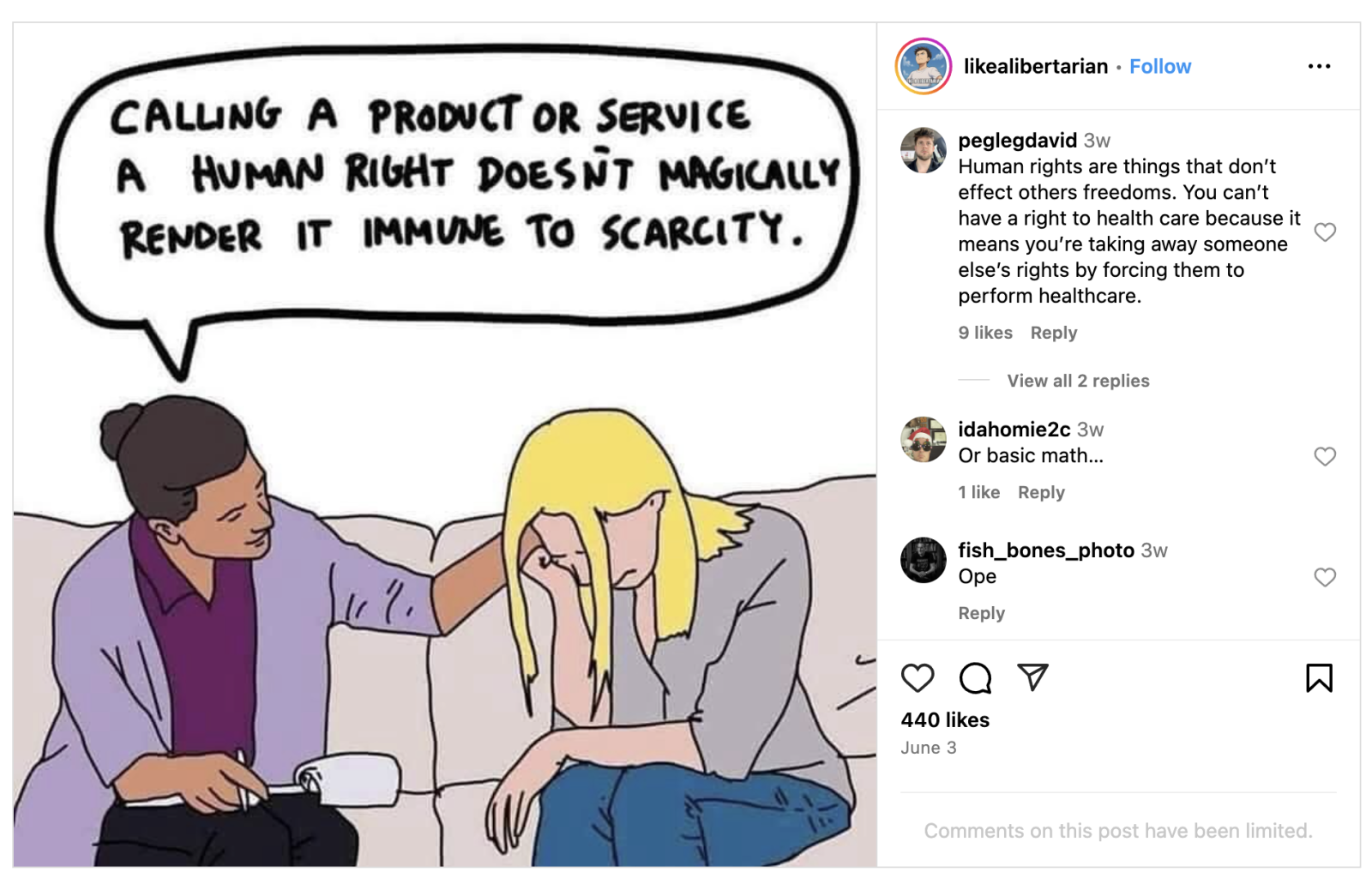
Let people die of preventable things, just don't disrupt the purity of my philosophic beliefs.
This flavor of libertarianism is horseshit. Occasionally, an existential threat appears to remind us that ideological purity is 100% aspiration and 0% practicality. When such a crisis flares up, we stop what we're doing, start shoveling, and keep it up until the fire is out. In a recent example, public-private partnerships developed COVID-19 vaccines and brought a brutal pandemic to heel. Should we listen to the crazies and not develop a vaccine the next time around? RFK Jr. wants us to do exactly that.
No doubt, government made deadly mistakes in its response to COVID-19. In the aggregate though, the response saved millions more lives than it cost.
It's no accident that the MAGA propaganda engine is firing on all cylinders to paint the entirety of our COVID-19 mitigations, including vaccines, as left-wing overreach. Community, regional, and federal co-operation distributes power Trump and his enablers want to consolidate in the Oval Office. Trump burns so intensely for power, he is willing to toss his greatest accomplishment in public life, facilitating the development of COVID-19 vaccines, into the bonfire.
Libertarians think taxation is theft. Sometimes, it is. But a robust private economy depends upon public projects which the private economy is often not interested in pursuing: Roads, bridges, railroads, power infrastructure, and electronic networks required to make commerce possible, and wide distribution of water, food, housing and healthcare required to keep workers healthy.
~ ~ ~
It's the nature of individual liberties to bump into each other. Civil jurisprudence comprises adjudications, healing of the literal or figurative bruises formed whenever freedoms and rights collide. In other words, no right is absolute. But rights ought not be tossed out because conditions apply to them. For example, if we can design a healthcare system with fewer unnecessary deaths, at a cost society can bear, shouldn't we do it? As we aspire to let free markets solve all our problems, should we not step in, by altering the legal framework of the private economy and with public service programs, when markets fail and people are dying?
Instead, we witness first-hand the dangers of economic and theocratic ideology twisted to serve the powerful at the expense of the general population. Enabled by the lie that government is universally wasteful and ineffective and the bizarre claim that mercy is "woke," essential supports, reliefs, and safeguards are being stripped away: consumer and environment protection, Medicaid, USAID, vaccine research, public broadcasting, voting rights, the Posse Comitatus Act, neutral courtroom justice, due process, disaster response and more, all weakened or eliminated. As right-wing violence escalates, Trump decries "radical left-wing lunatics" as pretext to "root them out" in dictatorial fashion. And Trump is just getting started.
It can seem as hopeless as trying to stop the rain, but we must rise up to diffuse this particular storm or it will drown us.

August 27, 2025
How Shall We Define Taconomics?
How Shall We Define Taconomics?
... In which a VoteVets meme leads to robust, generally civil discussion of how to classify what Trump is doing to our economy.
VoteVets, an anti-Trump and somewhat left leaning political organization, today posted this meme:
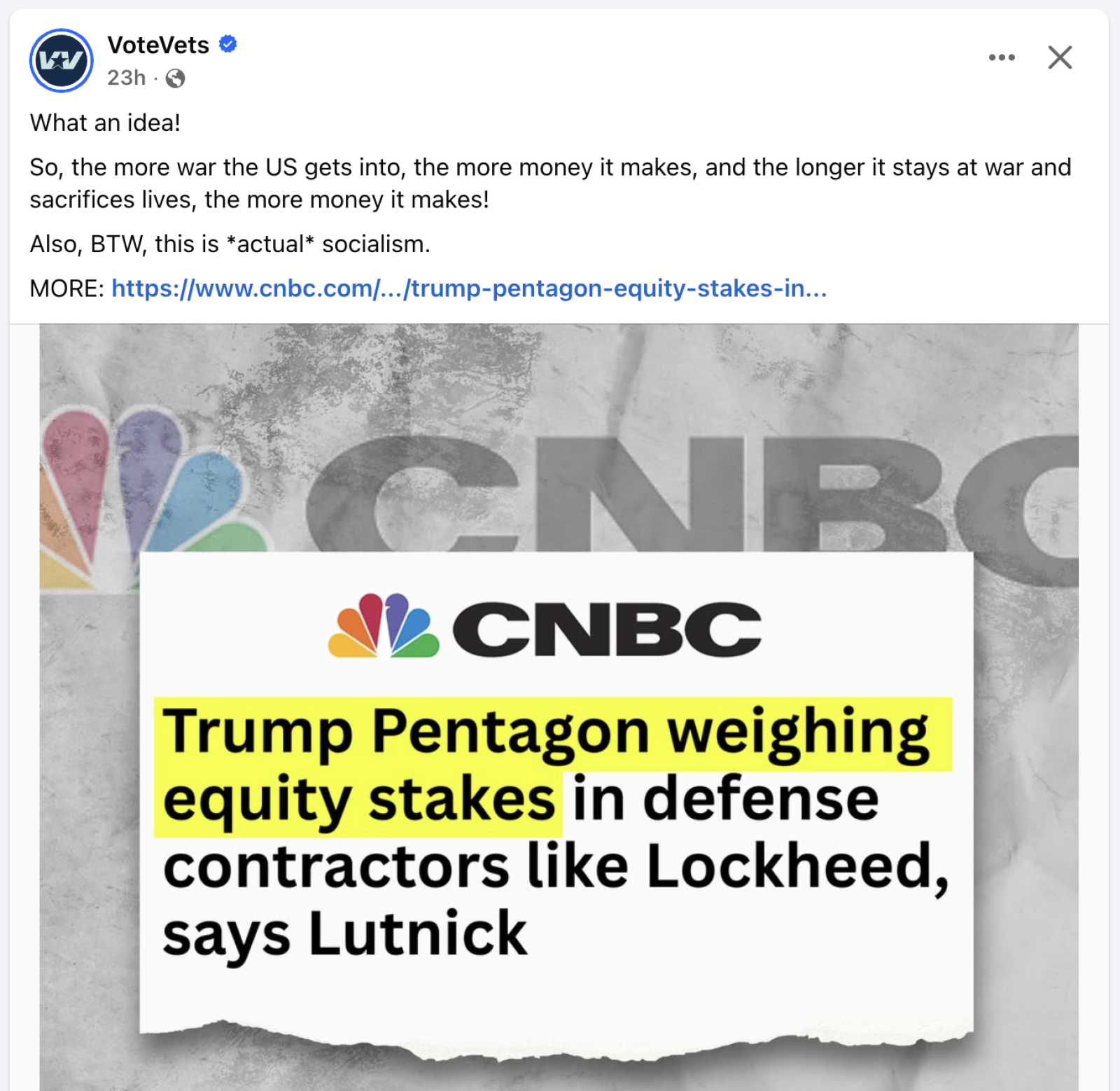
The CNBC story could yield a dozen memes more provocative than this one, given the bravado expressed by Trump and his minions. Trump said he would do deals like this "all day long."
Lutnick's announcement comes on the heels of the US government using CHIPS Act money to acquire a 10% stake in Intel, prompting libertarian Senator Rand Paul (R-KY) to write, "If socialism is government owning the means of production, wouldn’t the government owning part of Intel be a step toward socialism?" Are state-owned equity stakes in private companies really socialism, or something else?
In the comments of the VoteVets post, an interesting and generally civil* conversation is unfolding about what to call what one commenter labeled "Taconomics"—a term which deserves to catch on if it it's not catching on already.
* Commenters are calling Commerce Secretary Howard Lutnick "Nutlick," or alternatively, "Buttlick." Which, who can blame them?
* Commenters are calling Commerce Secretary Howard Lutnick "Nutlick," or alternatively, "Buttlick." Which, who can blame them?
John Davis posted this summary, which AI ought to show every time someone Googles the difference between socialism and communism:
Socialism
• Core Idea: The means of production (factories, resources, services) are owned or regulated by the community or the state to ensure fair distribution of wealth.
• Ownership: Can be mixed — both government and private ownership may exist.
• Economy: Still allows for markets, competition, and private property to some degree.
• Goal: Reduce inequality by providing social safety nets (healthcare, education, welfare, etc.) and limiting extreme wealth gaps.
• Examples in practice: Modern Scandinavian countries (like Sweden, Denmark, Norway) blend capitalism with strong social programs → often called “democratic socialism” or “social democracy.”
Communism
• Core Idea: A classless, stateless society where all property is commonly owned, and wealth is distributed strictly “according to need.”
• Ownership: No private property — all means of production are collectively owned.
• Economy: No markets or private businesses in pure communism. Distribution is centrally planned or done communally.
• Goal: Eliminate all class distinctions — everyone contributes according to ability and receives according to need.
• Examples in practice: The Soviet Union, Maoist China, Cuba — though these were/are more “state socialism” or “authoritarian communism,” not the pure theoretical communism Karl Marx envisioned.
In short:
• Socialism = reformist, can coexist with democracy and capitalism, focuses on reducing inequality.
• Communism = revolutionary, seeks to abolish capitalism and private property altogether.
To re-create the labels for Taconomics people are using in the comments, you could use a randomizer to combine the following words into phrases: socialism, communism, Marxism, capitalism, fascism, oligarchy, gangsterism, extortion, bribery.
If forced to choose, I would classify Taconomics as "Socio-Communistic Gangster-Oligarchy." Or more simply, "Old Rich Man Power Games." Or, even simpler, "Bad For Us."
The feedback loop created when government owns part of a company which profits from Defense Department tax dollars cannot benefit the American people. Trump alone will decide what is done with the Government's equity stake. It places one more lever of control in his hands, and takes away what remains of the government's ability to award contracts impartially.
Perhaps it's clearer now why Trump wants to change the Defense Department to the War Department. If he can't have a Nobel Peace Prize, at least he can blow things up and make a buck from it, eight different ways.
December 28, 2021
Infrastructure Is a Bridge to Progress for All
by Steve Cickay
Infrastructure Is a Bridge to Progress for All
by Steve Cickay
In an age where political dysfunction is so rampant that obstruction and doing nothing is so often the rule, it was a pleasure to see in my own backyard something new and wonderful created that pleased everyone: the Scudder Falls shared-use path. I dream for more such creations in the future.
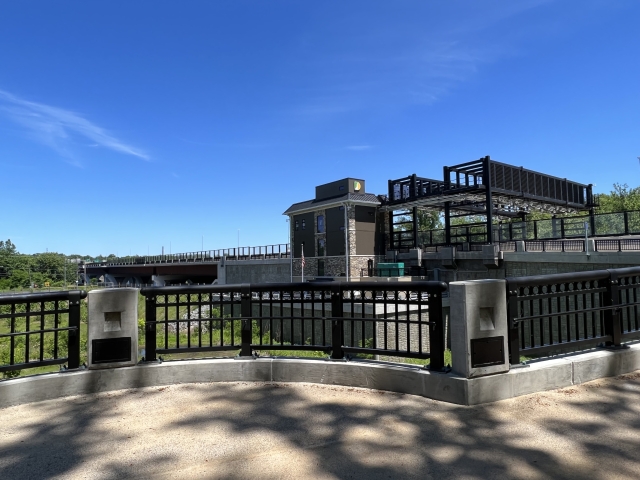
Recently, I took a walk across the new Scudder Falls shared-use path and saw smiles on every walker, runner and bicyclist I passed. I saw new views of our beautiful Delaware River as I lingered on the bridge, admiring both the engineering accomplishment and the surrounding natural beauty. In a few days I was on the bridge again and saw even more smiles.A vie
I am sure though that after a while, the novelty will wear off and people will consider this once new path as part of the expected landscape and grow to assume that, of course, it was always here and unimaginable that once we were without it.
But reflecting on America’s past, we see that what has made our country great were people of vision who did not simply see the way things are, but had the courage and wisdom to dream visions of what could be.
Once America had no transcontinental railroads, no interstate highways, and no airports. But wise Americans of all political parties saw a vision of how an America could be built so that it could be better for all. And so bridges were built to these new things which people soon could not conceive that they once did not exist.
Once America had no funded kindergarten through 12th grade education for children, no laws preventing young children from working in factories, no such thing as a weekend or a 40 hour work week, and only poverty and illness awaiting most of the elderly in their “golden years.” But wise Americans saw a vision of how an America could be built so that all children would be guaranteed an education, workers had the leisure of a weekend and evening, and the elderly had a healthy and secure retirement. The bridges of universal grade-school education, the 40 hour work week, Social Security and Medicare were built and people soon could not conceive that they once did not exist
Before us now are more visions of how to build back an America that will be better for all. There are plans proposed for even more education for our young children via universal pre-K, plans to lift millions of children out of poverty through the child tax credit, plans to help hard-working families with childcare and eldercare costs, plans to make medicine and healthcare more affordable for all, and plans to support energy systems that will help preserve our life-sustaining planet.
There are again those who wish to keep things the way they are and fail to see how much better America would be if we invest in building those bridges to a better future for all. But I hope that those who dream will prevail, as they have in the past, so that all Americans will one day soon find it inconceivable that these bridges once did not exist.
On my second walk across the bridge I saw a family of four bicycling, each with smiles on their faces. The parents were happy to see their children experiencing what a few days before had never existed. They saw them riding across that bridge to a happier, better future thanks to the wisdom of leaders who dreamed for a better America and did not simply and foolishly say no.
Please. Take that ride across that beautiful bridge, together, with all your fellow-Americans, to a better future for all.
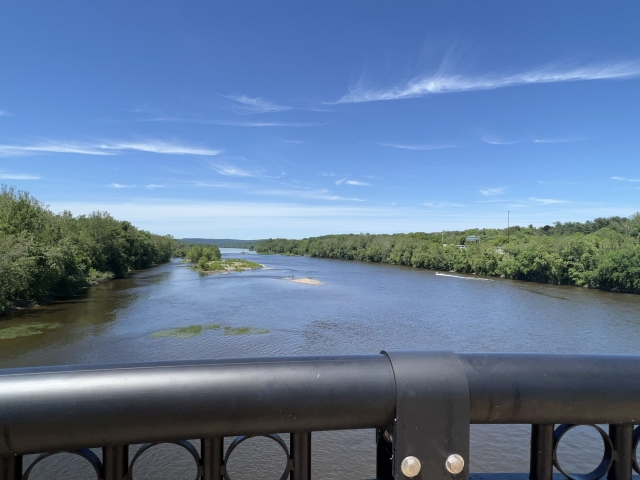
The Delaware River, facing North, viewed from the Scudder Falls shared-use path
December 13, 2021
The New Age of the Robber Barons
by Steve Cickay
The New Age of the Robber Barons
by Steve Cickay
While the ultrarich amuse themselves with rides into space, millions lack the basic necessities of life.
Jeff Bezos and Richard Branson spend millions developing space tourism for the rich, blasting themselves and rich customers into brief joyrides into space. This wasteful extravagance is yet another reminder that income inequality has reached new heights of obscenity. And the media covers this ostentatious vulgarity with such starry-eyed sycophancy.
Millions of people on Earth lack the basics of food, housing and medical care. We race blindly to our species' extinction due to human-induced climate change. We are in the middle of a pandemic that has killed millions of people and billions are still unvaccinated.
Here in the United States, millions who could be vaccinated for free refuse to do so in great part due to the Republican Party’s self-serving politicization and anti-science ideology. And here in Pennsylvania we shamelessly have had a poverty minimum wage of $7.25 an hour for over 10 years.
What does this say about us as a society and its moral focus?
The billionaires’ focus is rather on spending their mountains of cash to give rich people more jollies. And the mega-corporations continue to not even pay any federal taxes. Thank goodness President Biden is trying to make the rich pay their fair share, but of course he has to fight the Republicans tooth and nail for this no-brainer.
So, enjoy the television visions of rich people having fun in space while you workers, without billions of dollars, contend with trying to afford health care, child care, and pre-K and college education for your children and will soon be struggling to survive from the adverse, often deadly, effects of climate change.
President Biden is also fighting to help you on these issues with his Build Back Better program, but of course he has to fight the Republicans for this as well.
Billionaires have a ticket to ride on the backs of their workers, who have no hope of getting off the ground without activism and reform.
Steve Cickay is a resident of Newtown. A version of this article was published in the Bucks County Courier Times.
SEARCH NEWS ITEMS
SEARCH ARTICLES
POSTS BY TYPE
POSTS BY TAG
POSTS BY MONTH